
 Common
 Uncommon
 Rare
 Epic
 Legendary
 Artifact
 Aquan
 City
 Foundry World
 Ionic
 Magmatic
 Ore
 Red
 Rime
 Ruin
 Sentient
 Spore
 Terran (Arctic)
 Terran (Arid)
 Terran (Barren)
 Terran (Oceanic)
 Terran (Verdant)
 Zephyr
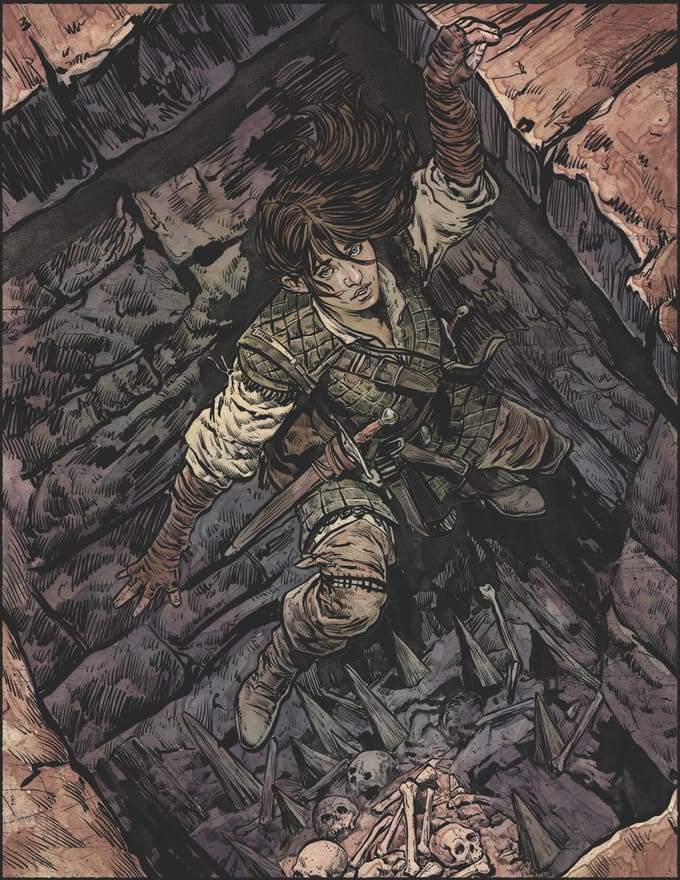
Environments
Every world type, region and exposure in the Environments tome, with what it costs to cross, the saves it demands and the creatures whose habitat it is. The chapters in Worldbuilding say how to use these at the table; this chapter is the reference they point at. 83 environments.
Accretion Disc
Extraplanetary
Infalling material around a collapsed object, heated by friction until it outshines a star. Matter in the disc moves inward, as does any vessel that stops using thrust. Time runs slow near the object, and a creature outside a hull takes tidal damage at the innermost band.
Exposure
Vacuum No pressure and no air to breathe, with survival measured in rounds.
- Countdown. Without a seal, a creature holds out for a number of rounds equal to its Constitution modifier, minimum 1. At the end of that time its hit points drop to -1, unless they are already lower, and it is dying. It cannot be stabilized or regain hit points until it can breathe.
- Decompressed. Exposure inflicts the Decompressed condition, which a return to pressure does not by itself remove.
- Holding your breath. Holding a breath in vacuum ruptures the lungs. A creature that does so takes 2d6 damage on the first round and gains no benefit from the attempt.
- Sound. Sound does not travel. Verbal spell components, shouted orders and Perception by hearing all fail across open vacuum. Suit comms and touch are the only channels.
- Unfiltered light. Without air to filter it, the star's output arrives unreduced. An hour of unshielded exposure in direct sunlight counts as a failed Contaminated Atmosphere save against radiological dose.
Extreme Heat Temperatures above about 100 degrees Fahrenheit in shade, or anywhere near a working vent. CON save, DC 10, rising by 1 for each hour after the first. End of each hour. One level of exhaustion.
- Sealed and armored. A creature in medium or heavy armor, or in a sealed suit without active cooling, has disadvantage on the save.
- Water. A creature with its full water ration has advantage on the save. One without any fails automatically.
- Cooled. Active cooling, a Rift effect naming heat, or Resistance to fire damage removes the save.
High Gravity Gravity above about 1.5g, where objects and creatures weigh more and falling damage is doubled. CON save, DC 12. End of each hour of exertion. One level of exhaustion.
- Weight. Carrying capacity is halved, and a creature's speed is reduced by 10 feet.
- Falls. Falling damage is doubled, and a fall of 10 feet or more knocks a creature Prone with no save.
- Ranged weapons. The long range of any thrown or ballistic weapon is halved.
- Adapted. A creature native to a high-gravity world, or one with a feature naming gravity, ignores all of the above.
Zero Gravity Free fall, where there is no down, no moving body stops on its own, and a missed handhold leaves a creature adrift.
- Movement. Moving requires a surface to push from. A creature with nothing in reach continues in the direction it last moved until it reaches something.
- Changing course. Changing direction mid-drift requires a DC 12 Dexterity (Acrobatics) check. On a failure the creature continues as it was.
- Melee. An unanchored melee attack has disadvantage and pushes the attacker 10 feet away from the target after it resolves.
- No falling. There is no up, no down and no falling damage. A creature cannot be knocked Prone, and the Prone condition does not apply.
- Mag boots. Magnetic boots or a tether remove every entry above while a ferrous surface is underfoot, at the cost of half movement.
Rift Flux Ambient Rift Energy at a high, unstable density, where channeling is stronger and less reliable. WIS save, DC 13. End of each hour. Your next spell attack roll has disadvantage, or the target of your next spell that forces a saving throw has advantage on it. Roll once on the Surge Table.
- Dense field. A spell cast here that deals damage or restores hit points adds its level to one of its damage or healing rolls, and a cantrip adds 1. A spell that does neither gains nothing. The bonus cannot be declined.
- Unstable. A natural 1 or 2 on a spell attack roll, a target's natural 19 or 20 on a saving throw against a spell, and any failed concentration save each roll on the Surge Table in the GM's Manual.
- Instruments. Anything calibrated against a stable Rift background reads wrong. Navigation, dating and detection checks that rely on one have disadvantage.
- Warded. A ward, a null field or a feature naming Rift density removes the save and the Surge rolls. The damage and healing bonus goes with them.
In play
Inward Every round spent in the disc without thrust moves the vessel one band closer to the object. There is no drifting outward.
Tidal High Gravity applies and worsens with each band. At the innermost band, a creature outside a hull takes 4d10 bludgeoning damage per round.
Time Close to the object, time runs slow relative to outside. A stay measured in hours costs days or years elsewhere, at the GM's rate.
Ionizing dose Unshielded, a creature gains a level of exhaustion each hour. A long rest does not clear it. A Medicine check at DC 12, a restorative spell or antiradiation drugs remove it. Rated shielding removes the effect, and most powered plate raises the interval to four hours.
Asteroid Belt
Extraplanetary
A ring of rubble that never accreted, usually between an inner and an outer world. Bodies average hundreds of thousands of kilometers apart, so a belt is far emptier than the popular picture of a hazard course. The danger in a belt is that a powered-down vessel hiding among the bodies is almost impossible to find.
Exposure
Vacuum No pressure and no air to breathe, with survival measured in rounds.
- Countdown. Without a seal, a creature holds out for a number of rounds equal to its Constitution modifier, minimum 1. At the end of that time its hit points drop to -1, unless they are already lower, and it is dying. It cannot be stabilized or regain hit points until it can breathe.
- Decompressed. Exposure inflicts the Decompressed condition, which a return to pressure does not by itself remove.
- Holding your breath. Holding a breath in vacuum ruptures the lungs. A creature that does so takes 2d6 damage on the first round and gains no benefit from the attempt.
- Sound. Sound does not travel. Verbal spell components, shouted orders and Perception by hearing all fail across open vacuum. Suit comms and touch are the only channels.
- Unfiltered light. Without air to filter it, the star's output arrives unreduced. An hour of unshielded exposure in direct sunlight counts as a failed Contaminated Atmosphere save against radiological dose.
Low Gravity Gravity below about 0.4g, where a push-off sends a creature farther than expected and stopping takes planning.
- Movement. Ground movement is normal, but any push-off sends the creature farther. A creature that Dashes continues an extra 10 feet in the same direction at the end of its turn unless it spends 5 feet stopping.
- Melee. A melee attack made without an anchor point pushes the attacker 5 feet away from the target after the attack resolves.
- Jumps and falls. Jump distances are tripled and falling damage is halved. A fall of under 40 feet does none.
- Carrying capacity. Carrying capacity is tripled. Mass is unchanged, so anything being carried is as hard to start and stop as it is at normal gravity.
- Mag boots. Magnetic boots or a tether remove every entry above while a ferrous surface is underfoot, at the cost of half movement.
In play
Empty Crossing a belt poses no piloting hazard. Bodies sit too far apart to matter unless someone has arranged them close together.
Hidden vessels Sensor checks to locate a powered-down vessel among the bodies have disadvantage and fail entirely beyond Long range.
Claims Each rock is claimed individually by filing, with no physical boundary. Most belt violence is over the filing.
Chronal Eddy
Extraplanetary
A region where time runs at a different rate from the space around it, usually near something that should no longer be running. Observers outside an eddy can see the difference, and creatures inside cannot.
Exposure
Rift Flux Ambient Rift Energy at a high, unstable density, where channeling is stronger and less reliable. WIS save, DC 13. End of each hour. Your next spell attack roll has disadvantage, or the target of your next spell that forces a saving throw has advantage on it. Roll once on the Surge Table.
- Dense field. A spell cast here that deals damage or restores hit points adds its level to one of its damage or healing rolls, and a cantrip adds 1. A spell that does neither gains nothing. The bonus cannot be declined.
- Unstable. A natural 1 or 2 on a spell attack roll, a target's natural 19 or 20 on a saving throw against a spell, and any failed concentration save each roll on the Surge Table in the GM's Manual.
- Instruments. Anything calibrated against a stable Rift background reads wrong. Navigation, dating and detection checks that rely on one have disadvantage.
- Warded. A ward, a null field or a feature naming Rift density removes the save and the Surge rolls. The damage and healing bonus goes with them.
In play
Initiative Initiative is rerolled at the start of every round.
Duration For an effect measured in rounds, the creature that created it rolls a d6 at the start of each of that creature's turns. On a 1 or 2 the effect ends, and on a 6 its remaining duration doubles.
Outside The GM sets the exchange rate before the party enters, or rolls a d6. On a 1 or 2, an hour inside is a day outside. On a 3 or 4, a day inside is an hour outside. On a 5, a minute inside is an hour outside. On a 6, an hour inside is a minute outside.
Cometary Halo
Extraplanetary
Loosely bound ice at the edge of a star's influence, where the system's sun is only the brightest star in the sky. Volatiles are free here to anyone willing to make the trip. The Axiom Combine has fabricators in several halos and has not checked on them in a decade.
Exposure
Vacuum No pressure and no air to breathe, with survival measured in rounds.
- Countdown. Without a seal, a creature holds out for a number of rounds equal to its Constitution modifier, minimum 1. At the end of that time its hit points drop to -1, unless they are already lower, and it is dying. It cannot be stabilized or regain hit points until it can breathe.
- Decompressed. Exposure inflicts the Decompressed condition, which a return to pressure does not by itself remove.
- Holding your breath. Holding a breath in vacuum ruptures the lungs. A creature that does so takes 2d6 damage on the first round and gains no benefit from the attempt.
- Sound. Sound does not travel. Verbal spell components, shouted orders and Perception by hearing all fail across open vacuum. Suit comms and touch are the only channels.
- Unfiltered light. Without air to filter it, the star's output arrives unreduced. An hour of unshielded exposure in direct sunlight counts as a failed Contaminated Atmosphere save against radiological dose.
Extreme Cold Temperatures below about zero degrees Fahrenheit, or any water near freezing, made worse by wind. CON save, DC 10, rising by 1 for each hour after the first. End of each hour. One level of exhaustion.
- Cold-weather gear. Proper layers, a sealed suit or a heated shelter removes the save. Wet layers give disadvantage on it instead.
- Immersion. A creature in near-freezing water makes the save each minute instead of each hour, and is Incapacitated at three levels of exhaustion.
- Gear. Unheated power cells lose half their charge, and any check made with bare hands after an hour of exposure has disadvantage.
- Adapted. A creature native to a cold world, or with resistance to cold damage, ignores the save.
In play
Distance Bodies are far from each other. A search of a halo takes weeks and is usually abandoned.
Volatiles Water, methane and ammonia are free to take. A vessel can refuel and resupply here indefinitely, at the cost of time.
No jurisdiction No jurisdiction reaches this far, and anything out here has been left undisturbed.
No light Heavily obscured. A creature without darkvision or a light source is Blinded, and a light source is visible to anything that can see at three times its own radius.
Dead Star
Extraplanetary
A burnt-out stellar remnant that still holds a system in orbit but no longer lights it. Charts mark them and traffic avoids them, because a comms blackout at that range looks the same as a disappearance.
Exposure
High Gravity Gravity above about 1.5g, where objects and creatures weigh more and falling damage is doubled. CON save, DC 12. End of each hour of exertion. One level of exhaustion.
- Weight. Carrying capacity is halved, and a creature's speed is reduced by 10 feet.
- Falls. Falling damage is doubled, and a fall of 10 feet or more knocks a creature Prone with no save.
- Ranged weapons. The long range of any thrown or ballistic weapon is halved.
- Adapted. A creature native to a high-gravity world, or one with a feature naming gravity, ignores all of the above.
In play
No light Sight beyond Close range requires a carried light source, because no ambient light reaches or reflects off anything here.
No signal Comms do not leave the well. A vessel inside is out of contact for as long as it stays.
Orbits The remnant's mass is unchanged, so all bodies that orbited the star still orbit it, in the dark.
Ionizing dose Unshielded, a creature gains a level of exhaustion each hour. A long rest does not clear it. A Medicine check at DC 12, a restorative spell or antiradiation drugs remove it. Rated shielding removes the effect, and most powered plate raises the interval to four hours.
Debris Shoal
Extraplanetary
A debris shoal is a field of fragments from a battle, a collision or a failed station, still holding its orbit. Salvage crews work shoals, and other ship traffic goes around them.
Exposure
Vacuum No pressure and no air to breathe, with survival measured in rounds.
- Countdown. Without a seal, a creature holds out for a number of rounds equal to its Constitution modifier, minimum 1. At the end of that time its hit points drop to -1, unless they are already lower, and it is dying. It cannot be stabilized or regain hit points until it can breathe.
- Decompressed. Exposure inflicts the Decompressed condition, which a return to pressure does not by itself remove.
- Holding your breath. Holding a breath in vacuum ruptures the lungs. A creature that does so takes 2d6 damage on the first round and gains no benefit from the attempt.
- Sound. Sound does not travel. Verbal spell components, shouted orders and Perception by hearing all fail across open vacuum. Suit comms and touch are the only channels.
- Unfiltered light. Without air to filter it, the star's output arrives unreduced. An hour of unshielded exposure in direct sunlight counts as a failed Contaminated Atmosphere save against radiological dose.
Zero Gravity Free fall, where there is no down, no moving body stops on its own, and a missed handhold leaves a creature adrift.
- Movement. Moving requires a surface to push from. A creature with nothing in reach continues in the direction it last moved until it reaches something.
- Changing course. Changing direction mid-drift requires a DC 12 Dexterity (Acrobatics) check. On a failure the creature continues as it was.
- Melee. An unanchored melee attack has disadvantage and pushes the attacker 10 feet away from the target after it resolves.
- No falling. There is no up, no down and no falling damage. A creature cannot be knocked Prone, and the Prone condition does not apply.
- Mag boots. Magnetic boots or a tether remove every entry above while a ferrous surface is underfoot, at the cost of half movement.
In play
Ship scale A vessel inside a shoal makes a DC 15 Piloting check each round or takes 2d10 hull damage.
Personal scale A creature on foot in a suit treats the shoal as difficult terrain, with full cover available in any direction.
Salvage The wreckage belonged to someone, and each shoal holds salvage worth the trip.
Deep Space
Extraplanetary
Interstellar space has about one atom per cubic centimeter, almost no light, and distances that are only practical to cross by hyperlane. No traffic passes through, so a stranded vessel is not found.
Exposure
Vacuum No pressure and no air to breathe, with survival measured in rounds.
- Countdown. Without a seal, a creature holds out for a number of rounds equal to its Constitution modifier, minimum 1. At the end of that time its hit points drop to -1, unless they are already lower, and it is dying. It cannot be stabilized or regain hit points until it can breathe.
- Decompressed. Exposure inflicts the Decompressed condition, which a return to pressure does not by itself remove.
- Holding your breath. Holding a breath in vacuum ruptures the lungs. A creature that does so takes 2d6 damage on the first round and gains no benefit from the attempt.
- Sound. Sound does not travel. Verbal spell components, shouted orders and Perception by hearing all fail across open vacuum. Suit comms and touch are the only channels.
- Unfiltered light. Without air to filter it, the star's output arrives unreduced. An hour of unshielded exposure in direct sunlight counts as a failed Contaminated Atmosphere save against radiological dose.
Extreme Cold Temperatures below about zero degrees Fahrenheit, or any water near freezing, made worse by wind. CON save, DC 10, rising by 1 for each hour after the first. End of each hour. One level of exhaustion.
- Cold-weather gear. Proper layers, a sealed suit or a heated shelter removes the save. Wet layers give disadvantage on it instead.
- Immersion. A creature in near-freezing water makes the save each minute instead of each hour, and is Incapacitated at three levels of exhaustion.
- Gear. Unheated power cells lose half their charge, and any check made with bare hands after an hour of exposure has disadvantage.
- Adapted. A creature native to a cold world, or with resistance to cold damage, ignores the save.
Zero Gravity Free fall, where there is no down, no moving body stops on its own, and a missed handhold leaves a creature adrift.
- Movement. Moving requires a surface to push from. A creature with nothing in reach continues in the direction it last moved until it reaches something.
- Changing course. Changing direction mid-drift requires a DC 12 Dexterity (Acrobatics) check. On a failure the creature continues as it was.
- Melee. An unanchored melee attack has disadvantage and pushes the attacker 10 feet away from the target after it resolves.
- No falling. There is no up, no down and no falling damage. A creature cannot be knocked Prone, and the Prone condition does not apply.
- Mag boots. Magnetic boots or a tether remove every entry above while a ferrous surface is underfoot, at the cost of half movement.
In play
No help A distress signal takes years to arrive anywhere, so rescue depends on what is aboard.
Cold An unpowered hull takes days to lose its heat, which is longer than the air lasts.
Navigation Position is fixed by pulsar or by chart. A vessel that has lost both has no procedure for finding its position.
Ionizing dose Unshielded, a creature gains a level of exhaustion each hour. A long rest does not clear it. A Medicine check at DC 12, a restorative spell or antiradiation drugs remove it. Rated shielding removes the effect, and most powered plate raises the interval to four hours.
No light Heavily obscured. A creature without darkvision or a light source is Blinded, and a light source is visible to anything that can see at three times its own radius.
Derelict Hull
Extraplanetary
A derelict hull is a ship adrift with its power out. It is the most common extraplanetary environment in which a party fights. Salvage law holds that a hull under way belongs to its owner and a hull adrift belongs to whoever boards it, and the Axiom Combine's salvagers apply that rule loosely.
Exposure
Vacuum No pressure and no air to breathe, with survival measured in rounds.
- Countdown. Without a seal, a creature holds out for a number of rounds equal to its Constitution modifier, minimum 1. At the end of that time its hit points drop to -1, unless they are already lower, and it is dying. It cannot be stabilized or regain hit points until it can breathe.
- Decompressed. Exposure inflicts the Decompressed condition, which a return to pressure does not by itself remove.
- Holding your breath. Holding a breath in vacuum ruptures the lungs. A creature that does so takes 2d6 damage on the first round and gains no benefit from the attempt.
- Sound. Sound does not travel. Verbal spell components, shouted orders and Perception by hearing all fail across open vacuum. Suit comms and touch are the only channels.
- Unfiltered light. Without air to filter it, the star's output arrives unreduced. An hour of unshielded exposure in direct sunlight counts as a failed Contaminated Atmosphere save against radiological dose.
Extreme Cold Temperatures below about zero degrees Fahrenheit, or any water near freezing, made worse by wind. CON save, DC 10, rising by 1 for each hour after the first. End of each hour. One level of exhaustion.
- Cold-weather gear. Proper layers, a sealed suit or a heated shelter removes the save. Wet layers give disadvantage on it instead.
- Immersion. A creature in near-freezing water makes the save each minute instead of each hour, and is Incapacitated at three levels of exhaustion.
- Gear. Unheated power cells lose half their charge, and any check made with bare hands after an hour of exposure has disadvantage.
- Adapted. A creature native to a cold world, or with resistance to cold damage, ignores the save.
Zero Gravity Free fall, where there is no down, no moving body stops on its own, and a missed handhold leaves a creature adrift.
- Movement. Moving requires a surface to push from. A creature with nothing in reach continues in the direction it last moved until it reaches something.
- Changing course. Changing direction mid-drift requires a DC 12 Dexterity (Acrobatics) check. On a failure the creature continues as it was.
- Melee. An unanchored melee attack has disadvantage and pushes the attacker 10 feet away from the target after it resolves.
- No falling. There is no up, no down and no falling damage. A creature cannot be knocked Prone, and the Prone condition does not apply.
- Mag boots. Magnetic boots or a tether remove every entry above while a ferrous surface is underfoot, at the cost of half movement.
In play
No power Doors are manual, lifts are open shafts and no alarms or announcements sound. Powered gear runs on its own cells.
Layout Corridors are Close range throughout and a boarding action is fought at that distance. Ranged weapons lose their advantage entirely.
Cause A derelict stopped for a reason. A DC 15 Investigation check on the bridge or in the log identifies it before the party meets it.
No light Heavily obscured. A creature without darkvision or a light source is Blinded, and a light source is visible to anything that can see at three times its own radius.
Found here (46)
- Apparition
- Bat
- Black Ooze
- Crab
- Cybernetic Battle Troll
- Ghost
- Giant Centipede
- Giant Owl
- Giant Rat
- Gremlin Gaunt
- HDF Commando
- Halcyion Augmentate
- Keth'rassa Marine
- Maintenance Unit
- Mimic
- Minor Water Elemental
- Miseria
- Mogwai
- Mycelai
- Myr'Khruul Abomination
- Myr'Khruul Adept
- Myr'Khruul Drone
- Myr'Khruul Hive Mind
- Myr'Khruul Invoker
- Myr'Khruul Minder
- Myr'Khruul Mindmaester
- Myr'Khruul Parasite
- Myr'Khruul Stalker
- Nosferatu
- Poltergeist
- Psionic Parasite
- Rat
- Reefclaw
- Rust Crawler
- Shade
- Shadow Demon
- Skree
- Snake
- Spore Squid
- Syndicate Slaver
- Vermin Swarm
- Void Crawler
- Void Hound
- Water Elemental
- Weasel
- Wraith
Gravity Well
Extraplanetary
A collapsed star remnant or an object the Mythar left. Whatever the cause, moving toward the center is easy and moving away from it is hard.
Exposure
High Gravity Gravity above about 1.5g, where objects and creatures weigh more and falling damage is doubled. CON save, DC 12. End of each hour of exertion. One level of exhaustion.
- Weight. Carrying capacity is halved, and a creature's speed is reduced by 10 feet.
- Falls. Falling damage is doubled, and a fall of 10 feet or more knocks a creature Prone with no save.
- Ranged weapons. The long range of any thrown or ballistic weapon is halved.
- Adapted. A creature native to a high-gravity world, or one with a feature naming gravity, ignores all of the above.
In play
Gradient A creature moving toward the center moves at double speed, and a creature moving away from it moves at half speed. A ranged attack whose path crosses the gradient treats its target as one range band farther away, so a Close target counts as Medium.
Falling A creature that ends its turn in the well without being anchored makes a DC 13 Strength (Athletics) check. A creature is anchored while it holds a fixed handhold, wears magnetic boots on a hull, or is aboard a vehicle under thrust. On a failure, the creature is pulled 20 feet toward the center.
High Orbit
Extraplanetary
The region at and above geostationary altitude. Orbits here are slow and stable, and outside the drag that clears low orbit of neglected objects. Comms relays, weapon platforms and stations their owners do not want inspected sit here, and they stay where they are put.
Exposure
Vacuum No pressure and no air to breathe, with survival measured in rounds.
- Countdown. Without a seal, a creature holds out for a number of rounds equal to its Constitution modifier, minimum 1. At the end of that time its hit points drop to -1, unless they are already lower, and it is dying. It cannot be stabilized or regain hit points until it can breathe.
- Decompressed. Exposure inflicts the Decompressed condition, which a return to pressure does not by itself remove.
- Holding your breath. Holding a breath in vacuum ruptures the lungs. A creature that does so takes 2d6 damage on the first round and gains no benefit from the attempt.
- Sound. Sound does not travel. Verbal spell components, shouted orders and Perception by hearing all fail across open vacuum. Suit comms and touch are the only channels.
- Unfiltered light. Without air to filter it, the star's output arrives unreduced. An hour of unshielded exposure in direct sunlight counts as a failed Contaminated Atmosphere save against radiological dose.
Zero Gravity Free fall, where there is no down, no moving body stops on its own, and a missed handhold leaves a creature adrift.
- Movement. Moving requires a surface to push from. A creature with nothing in reach continues in the direction it last moved until it reaches something.
- Changing course. Changing direction mid-drift requires a DC 12 Dexterity (Acrobatics) check. On a failure the creature continues as it was.
- Melee. An unanchored melee attack has disadvantage and pushes the attacker 10 feet away from the target after it resolves.
- No falling. There is no up, no down and no falling damage. A creature cannot be knocked Prone, and the Prone condition does not apply.
- Mag boots. Magnetic boots or a tether remove every entry above while a ferrous surface is underfoot, at the cost of half movement.
In play
Stationkeeping An object here holds its position over one point on the world indefinitely.
Delay Signal to the surface and back takes a noticeable fraction of a second. Remote operation of anything at close quarters has disadvantage.
No decay There is no drag. Wreckage, mines and abandoned platforms stay on station for centuries.
Ionizing dose Unshielded, a creature gains a level of exhaustion each hour. A long rest does not clear it. A Medicine check at DC 12, a restorative spell or antiradiation drugs remove it. Rated shielding removes the effect, and most powered plate raises the interval to four hours.
Found here (3)
Hyperlane Corridor
Extraplanetary
A surveyed translation route between two points, held open by beacons and by traffic. Checkpoints and raiders gather where the traffic is, and a published schedule is a security risk.
Exposure
Vacuum No pressure and no air to breathe, with survival measured in rounds.
- Countdown. Without a seal, a creature holds out for a number of rounds equal to its Constitution modifier, minimum 1. At the end of that time its hit points drop to -1, unless they are already lower, and it is dying. It cannot be stabilized or regain hit points until it can breathe.
- Decompressed. Exposure inflicts the Decompressed condition, which a return to pressure does not by itself remove.
- Holding your breath. Holding a breath in vacuum ruptures the lungs. A creature that does so takes 2d6 damage on the first round and gains no benefit from the attempt.
- Sound. Sound does not travel. Verbal spell components, shouted orders and Perception by hearing all fail across open vacuum. Suit comms and touch are the only channels.
- Unfiltered light. Without air to filter it, the star's output arrives unreduced. An hour of unshielded exposure in direct sunlight counts as a failed Contaminated Atmosphere save against radiological dose.
Zero Gravity Free fall, where there is no down, no moving body stops on its own, and a missed handhold leaves a creature adrift.
- Movement. Moving requires a surface to push from. A creature with nothing in reach continues in the direction it last moved until it reaches something.
- Changing course. Changing direction mid-drift requires a DC 12 Dexterity (Acrobatics) check. On a failure the creature continues as it was.
- Melee. An unanchored melee attack has disadvantage and pushes the attacker 10 feet away from the target after it resolves.
- No falling. There is no up, no down and no falling damage. A creature cannot be knocked Prone, and the Prone condition does not apply.
- Mag boots. Magnetic boots or a tether remove every entry above while a ferrous surface is underfoot, at the cost of half movement.
In play
Travel roll A leg is a single Piloting check against the distance DC. The roll sets what the leg costs, and the leg always completes.
Predictable Traffic on a lane runs to a schedule that can be read from a dock manifest, and raids are planned from those manifests.
Checkpoints A lane through claimed space includes an inspection. Avoiding it means leaving the lane, and off-lane transit raises the DC by 4.
Found here (36)
- Alien Conqueror
- Aurel Militarum Marine
- Aurelion Adjudicator
- Black Meridian Pirate
- Bounty Bot
- Camel
- Chosen of Khaos
- D'horvakk Heavy Trooper
- HDF Captain
- HDF Commander
- HDF Commando
- HDF Pilot
- HDF Robo-Hound
- HDF Ronin Droid
- HDF Trooper
- Halcyion Chaplain
- Halcyion Crusader Knight
- Halcyion Engineer
- Halcyion Holy Knight
- Halfling
- Hobgoblin Mercenary
- Ice Giant Star Raider
- Intergalactic Conqueror
- Istryxian Scout
- Istryxian Warrior
- Keth'rassa Medic
- Legendary Smuggler
- Legendary Warlord
- Merchant Guard
- Qy'reen Engineer
- Sea Serpent
- Star Shark
- Syndicate Smuggler
- Thuul Warrior
- Zyrrak Legend
- Zyrrak Raider
Lagrange Point
Extraplanetary
Points where the gravity of a world and its star, or a world and its moon, balance so that a station holds position without spending fuel. There are five per pair, and two of them are stable. Those two are the most valuable real estate in any system.
Exposure
Vacuum No pressure and no air to breathe, with survival measured in rounds.
- Countdown. Without a seal, a creature holds out for a number of rounds equal to its Constitution modifier, minimum 1. At the end of that time its hit points drop to -1, unless they are already lower, and it is dying. It cannot be stabilized or regain hit points until it can breathe.
- Decompressed. Exposure inflicts the Decompressed condition, which a return to pressure does not by itself remove.
- Holding your breath. Holding a breath in vacuum ruptures the lungs. A creature that does so takes 2d6 damage on the first round and gains no benefit from the attempt.
- Sound. Sound does not travel. Verbal spell components, shouted orders and Perception by hearing all fail across open vacuum. Suit comms and touch are the only channels.
- Unfiltered light. Without air to filter it, the star's output arrives unreduced. An hour of unshielded exposure in direct sunlight counts as a failed Contaminated Atmosphere save against radiological dose.
Zero Gravity Free fall, where there is no down, no moving body stops on its own, and a missed handhold leaves a creature adrift.
- Movement. Moving requires a surface to push from. A creature with nothing in reach continues in the direction it last moved until it reaches something.
- Changing course. Changing direction mid-drift requires a DC 12 Dexterity (Acrobatics) check. On a failure the creature continues as it was.
- Melee. An unanchored melee attack has disadvantage and pushes the attacker 10 feet away from the target after it resolves.
- No falling. There is no up, no down and no falling damage. A creature cannot be knocked Prone, and the Prone condition does not apply.
- Mag boots. Magnetic boots or a tether remove every entry above while a ferrous surface is underfoot, at the cost of half movement.
In play
Free station No fuel is spent holding position. Every long-term installation that is not in orbit of a body is at a Lagrange point.
Crowded The stable points collect dust, asteroids and every parked or abandoned object. Sensor checks there have disadvantage because of the clutter.
Jurisdiction A Lagrange point belongs to whoever holds the world, and claims to it are contested more often than the world is.
Found here (25)
- Aurel Militarum Engineer
- Aurel Militarum Marine
- Aurel Militarum Officer
- Aurel Militarum Trooper
- Aurelion Adjudicator
- Aurelion Aristocrat
- Aurelion High Guard
- Aurelion Phoenix
- Aurelion Synth
- Axiom Fabricator
- ESC Interdiction Unit
- ESC Sector Commander
- Echelon Corporation Executive
- Griffon
- HDF Captain
- HDF Sergeant
- HDF Trooper
- Halcyion Augmentate
- Halcyion Champion
- Halcyion Preceptor
- Halcyion Tech-Priest
- Thuul Drone
- Thuul Hive Patriarch
- Thuul Hunter
- Thuul Warrior
Low Orbit
Extraplanetary
The orbital band a few hundred kilometers above a world, where a body circles in about ninety minutes and drag still matters. Every settled world has a shell of traffic, debris and hardware at this altitude, and the right to place objects in it is disputed.
Exposure
Vacuum No pressure and no air to breathe, with survival measured in rounds.
- Countdown. Without a seal, a creature holds out for a number of rounds equal to its Constitution modifier, minimum 1. At the end of that time its hit points drop to -1, unless they are already lower, and it is dying. It cannot be stabilized or regain hit points until it can breathe.
- Decompressed. Exposure inflicts the Decompressed condition, which a return to pressure does not by itself remove.
- Holding your breath. Holding a breath in vacuum ruptures the lungs. A creature that does so takes 2d6 damage on the first round and gains no benefit from the attempt.
- Sound. Sound does not travel. Verbal spell components, shouted orders and Perception by hearing all fail across open vacuum. Suit comms and touch are the only channels.
- Unfiltered light. Without air to filter it, the star's output arrives unreduced. An hour of unshielded exposure in direct sunlight counts as a failed Contaminated Atmosphere save against radiological dose.
Zero Gravity Free fall, where there is no down, no moving body stops on its own, and a missed handhold leaves a creature adrift.
- Movement. Moving requires a surface to push from. A creature with nothing in reach continues in the direction it last moved until it reaches something.
- Changing course. Changing direction mid-drift requires a DC 12 Dexterity (Acrobatics) check. On a failure the creature continues as it was.
- Melee. An unanchored melee attack has disadvantage and pushes the attacker 10 feet away from the target after it resolves.
- No falling. There is no up, no down and no falling damage. A creature cannot be knocked Prone, and the Prone condition does not apply.
- Mag boots. Magnetic boots or a tether remove every entry above while a ferrous surface is underfoot, at the cost of half movement.
In play
Orbital mechanics No object holds a position. Matching another object requires a DC 12 Piloting check. On a failure the vessel arrives on the next pass, ninety minutes later.
Line of sight The whole day side of the world is visible, and so is anything on it. Concealment from orbit requires overhead cover, and distance does not provide it.
Debris Fragments move at orbital speed. A vessel that stays stationary makes a DC 12 Piloting check each hour or takes 2d10 damage to the hull.
Ionizing dose Unshielded, a creature gains a level of exhaustion each hour. A long rest does not clear it. A Medicine check at DC 12, a restorative spell or antiradiation drugs remove it. Rated shielding removes the effect, and most powered plate raises the interval to four hours.
Nebula
Extraplanetary
A cloud of gas and dust that is emptier than anything a hull can produce but blocks all sensors because of its extent. The Black Meridian sits inside one, and the Syndicate's independence rests on knowing the corridor through it.
Exposure
Vacuum No pressure and no air to breathe, with survival measured in rounds.
- Countdown. Without a seal, a creature holds out for a number of rounds equal to its Constitution modifier, minimum 1. At the end of that time its hit points drop to -1, unless they are already lower, and it is dying. It cannot be stabilized or regain hit points until it can breathe.
- Decompressed. Exposure inflicts the Decompressed condition, which a return to pressure does not by itself remove.
- Holding your breath. Holding a breath in vacuum ruptures the lungs. A creature that does so takes 2d6 damage on the first round and gains no benefit from the attempt.
- Sound. Sound does not travel. Verbal spell components, shouted orders and Perception by hearing all fail across open vacuum. Suit comms and touch are the only channels.
- Unfiltered light. Without air to filter it, the star's output arrives unreduced. An hour of unshielded exposure in direct sunlight counts as a failed Contaminated Atmosphere save against radiological dose.
Zero Gravity Free fall, where there is no down, no moving body stops on its own, and a missed handhold leaves a creature adrift.
- Movement. Moving requires a surface to push from. A creature with nothing in reach continues in the direction it last moved until it reaches something.
- Changing course. Changing direction mid-drift requires a DC 12 Dexterity (Acrobatics) check. On a failure the creature continues as it was.
- Melee. An unanchored melee attack has disadvantage and pushes the attacker 10 feet away from the target after it resolves.
- No falling. There is no up, no down and no falling damage. A creature cannot be knocked Prone, and the Prone condition does not apply.
- Mag boots. Magnetic boots or a tether remove every entry above while a ferrous surface is underfoot, at the cost of half movement.
In play
Opaque Sensors, comms and targeting are limited to Close range throughout. No object inside can be detected from outside, and sensors inside cannot detect anything outside.
Charted corridors A route through a nebula is held as knowledge and has no marked lane. Without a navigator who holds it, a transit is a DC 22 check and a failure does not fail safe.
Ionization An ion nebula grounds a hull's charge unpredictably. Powered weapons misfire on a natural 1 and shields recharge at half rate.
No light Heavily obscured. A creature without darkvision or a light source is Blinded, and a light source is visible to anything that can see at three times its own radius.
Null Field
Extraplanetary
A null field is the inverse of a Bloom, and rarer. The Axiom Combine maps them and builds vaults in them, since nothing can teleport into one.
In play
No channeling No spell can be cast, sustained or ended inside the field. Ongoing effects are suspended, not dispelled, and resume on leaving.
Stored charge Powered gear runs only on the charge it holds. Anything that draws on the Rift is inert, including most cybernetics above Tier IV.
Radiation Belt
Extraplanetary
A magnetosphere captures the solar wind and holds it in torus-shaped belts around the world. The field that protects the surface concentrates the dose in the belts, so a safe route goes above or below a belt and never through it.
Exposure
Vacuum No pressure and no air to breathe, with survival measured in rounds.
- Countdown. Without a seal, a creature holds out for a number of rounds equal to its Constitution modifier, minimum 1. At the end of that time its hit points drop to -1, unless they are already lower, and it is dying. It cannot be stabilized or regain hit points until it can breathe.
- Decompressed. Exposure inflicts the Decompressed condition, which a return to pressure does not by itself remove.
- Holding your breath. Holding a breath in vacuum ruptures the lungs. A creature that does so takes 2d6 damage on the first round and gains no benefit from the attempt.
- Sound. Sound does not travel. Verbal spell components, shouted orders and Perception by hearing all fail across open vacuum. Suit comms and touch are the only channels.
- Unfiltered light. Without air to filter it, the star's output arrives unreduced. An hour of unshielded exposure in direct sunlight counts as a failed Contaminated Atmosphere save against radiological dose.
Magnetic Disturbance A world's or star's magnetic field in upheaval, so that instruments give false readings and comms fail.
- Instruments. Navigation and comms fail beyond Long range. Any check made with electronic assistance has disadvantage.
- Powered gear. Powered weapons and cybernetics stutter: a natural 1 on an attack or a check using them means the item is unusable until the end of the next turn.
- Induced current. Long conductors take on induced current. Unshielded power and data runs fail, and a creature in contact with one takes 2d6 lightning damage.
- Channeling. On a world with an active Rift tether, a natural 1 on a spell attack roll, or a target's natural 20 on a saving throw against a spell, rolls on the Surge Table.
Zero Gravity Free fall, where there is no down, no moving body stops on its own, and a missed handhold leaves a creature adrift.
- Movement. Moving requires a surface to push from. A creature with nothing in reach continues in the direction it last moved until it reaches something.
- Changing course. Changing direction mid-drift requires a DC 12 Dexterity (Acrobatics) check. On a failure the creature continues as it was.
- Melee. An unanchored melee attack has disadvantage and pushes the attacker 10 feet away from the target after it resolves.
- No falling. There is no up, no down and no falling damage. A creature cannot be knocked Prone, and the Prone condition does not apply.
- Mag boots. Magnetic boots or a tether remove every entry above while a ferrous surface is underfoot, at the cost of half movement.
In play
Transit A transit through a belt is one hour of Hard Radiation at DC 18 for anything without rated shielding. Every commercial lane routes around.
Instruments Magnetic Storm applies throughout. Navigation by instrument alone is at disadvantage.
Cover No patrols operate in a belt, so a vessel willing to take the dose is unlikely to be intercepted there.
Ionizing dose Unshielded, a creature gains a level of exhaustion each hour. A long rest does not clear it. A Medicine check at DC 12, a restorative spell or antiradiation drugs remove it. Rated shielding removes the effect, and most powered plate raises the interval to four hours.
Rift Bloom
Extraplanetary
A standing region of thinned boundary with no visible tear. Channelers sense one before any instrument detects it, and the Covenant of the Ebon Creed keeps a list of the ones it has found.
Exposure
Rift Flux Ambient Rift Energy at a high, unstable density, where channeling is stronger and less reliable. WIS save, DC 13. End of each hour. Your next spell attack roll has disadvantage, or the target of your next spell that forces a saving throw has advantage on it. Roll once on the Surge Table.
- Dense field. A spell cast here that deals damage or restores hit points adds its level to one of its damage or healing rolls, and a cantrip adds 1. A spell that does neither gains nothing. The bonus cannot be declined.
- Unstable. A natural 1 or 2 on a spell attack roll, a target's natural 19 or 20 on a saving throw against a spell, and any failed concentration save each roll on the Surge Table in the GM's Manual.
- Instruments. Anything calibrated against a stable Rift background reads wrong. Navigation, dating and detection checks that rely on one have disadvantage.
- Warded. A ward, a null field or a feature naming Rift density removes the save and the Surge rolls. The damage and healing bonus goes with them.
In play
Channeling Inside a Bloom, spell attack rolls have advantage and creatures have disadvantage on saving throws against spells. A natural 1 on a spell attack roll, or a target's natural 20 on a saving throw against a spell, rolls on the Surge Table.
Planar pull Anything native to another plane that enters the region will not willingly leave it.
Rift Breach
Extraplanetary
A failure in the boundary between the Prime Plane and another plane, at any scale from a hand's width to a system. Old breaches scar the ground around them permanently, and a new one has yet to fix which plane it connects to.
Exposure
Magnetic Disturbance A world's or star's magnetic field in upheaval, so that instruments give false readings and comms fail.
- Instruments. Navigation and comms fail beyond Long range. Any check made with electronic assistance has disadvantage.
- Powered gear. Powered weapons and cybernetics stutter: a natural 1 on an attack or a check using them means the item is unusable until the end of the next turn.
- Induced current. Long conductors take on induced current. Unshielded power and data runs fail, and a creature in contact with one takes 2d6 lightning damage.
- Channeling. On a world with an active Rift tether, a natural 1 on a spell attack roll, or a target's natural 20 on a saving throw against a spell, rolls on the Surge Table.
Rift Flux Ambient Rift Energy at a high, unstable density, where channeling is stronger and less reliable. WIS save, DC 13. End of each hour. Your next spell attack roll has disadvantage, or the target of your next spell that forces a saving throw has advantage on it. Roll once on the Surge Table.
- Dense field. A spell cast here that deals damage or restores hit points adds its level to one of its damage or healing rolls, and a cantrip adds 1. A spell that does neither gains nothing. The bonus cannot be declined.
- Unstable. A natural 1 or 2 on a spell attack roll, a target's natural 19 or 20 on a saving throw against a spell, and any failed concentration save each roll on the Surge Table in the GM's Manual.
- Instruments. Anything calibrated against a stable Rift background reads wrong. Navigation, dating and detection checks that rely on one have disadvantage.
- Warded. A ward, a null field or a feature naming Rift density removes the save and the Surge rolls. The damage and healing bonus goes with them.
In play
Channeling Within 60 feet of a breach, spell attack rolls have advantage and creatures have disadvantage on saving throws against spells. A natural 1 on a spell attack roll, or a target's natural 20 on a saving throw against a spell, rolls on the Surge Table.
Crossing A breach connects to one plane and only that one. What comes through arrives at the breach and stays within a distance the GM sets.
Scarring Ground within a mile of a breach older than a year is a Rift Scar. A creature in it makes a DC 12 Wisdom save once a day or gains a level of exhaustion.
Found here (102)
- Accursed Khaos Crawler
- Aculeus
- Adult Crystal Dragon
- Adult Mist Dragon
- Aether Drake
- Alkonost
- Ancient Woodland Spirit
- Archfae
- Baba Yaga
- Barbatos
- Catenarius
- Celestial Sentinel
- Chosen of Khaos
- Cornutus
- Crystal Elemental
- Cult Preacher
- Cult Priest
- Deceiver Demon
- Demon Lord
- Demon Prince
- Djinn
- Dragon Turtle
- Elder Crystal Dragon
- Elder Ifrit
- Elder Mist Dragon
- Eldritch Prince
- Ember Dwarf
- Ember Mephit
- Eyes of Stars
- Fallen Mythar
- Fanatic Cultist
- Flensed
- Furia
- Gelidus
- Gluttony Demon
- Gorella
- Greater Fiend
- Gremlin
- Hastatus
- Helionic Adjudicator
- Helionic Angel
- Helionic Arch-Angel
- Helionic Bellator
- Helionic Cherubim
- Helionic Herald
- Helionic Hound
- Helionic Seraphim
- Hellhound
- Hellspawn
- Hollow Hunter
- Ifrit
- Ifrit Swordsman
- Imp
- Khaos Abomination
- Khaos Spawn
- Khaos-Corrupted
- Lilim
- Magma Elemental
- Match Elemental
- Mazzik
- Mazzik Swarm-Caller
- Mist Dragon Hatchling
- Moloch
- Mouseling Hero
- Mythar Solar Sentinel
- Mytharil Steel Sentinel
- Necromancer Hierophant
- Nightmare
- Old One
- Pact Devil
- Pact Fiend
- Phoenix
- Pierrot Cat
- Pit Fiend
- Pit Fiend Champion
- Psionic Parasite
- Putrid Khaoshound
- Rana
- Rift Dog
- Rift Panther
- Rift Parasite
- Rift Spawn
- Satyr
- Satyr Sage
- Shade
- Shadow Demon
- Shemhazai
- Solar Drake
- Sprite
- Sylvarin
- Sylvarin Scout
- Sylvarin Sentinel
- Sylvarin Warden
- Tentator
- Terran Drake
- Titan
- Void Crawler
- Void Hound
- Voidling
- Water Sprite
- Young Crystal Dragon
- Young Mist Dragon
Ring System
Extraplanetary
Debris inside a world's Roche limit, where tides tear a body apart faster than it can reassemble. A ring is a dense, thin sheet that damages vessels crossing it, and it is the standard place to lose a pursuer.
Exposure
Vacuum No pressure and no air to breathe, with survival measured in rounds.
- Countdown. Without a seal, a creature holds out for a number of rounds equal to its Constitution modifier, minimum 1. At the end of that time its hit points drop to -1, unless they are already lower, and it is dying. It cannot be stabilized or regain hit points until it can breathe.
- Decompressed. Exposure inflicts the Decompressed condition, which a return to pressure does not by itself remove.
- Holding your breath. Holding a breath in vacuum ruptures the lungs. A creature that does so takes 2d6 damage on the first round and gains no benefit from the attempt.
- Sound. Sound does not travel. Verbal spell components, shouted orders and Perception by hearing all fail across open vacuum. Suit comms and touch are the only channels.
- Unfiltered light. Without air to filter it, the star's output arrives unreduced. An hour of unshielded exposure in direct sunlight counts as a failed Contaminated Atmosphere save against radiological dose.
Low Gravity Gravity below about 0.4g, where a push-off sends a creature farther than expected and stopping takes planning.
- Movement. Ground movement is normal, but any push-off sends the creature farther. A creature that Dashes continues an extra 10 feet in the same direction at the end of its turn unless it spends 5 feet stopping.
- Melee. A melee attack made without an anchor point pushes the attacker 5 feet away from the target after the attack resolves.
- Jumps and falls. Jump distances are tripled and falling damage is halved. A fall of under 40 feet does none.
- Carrying capacity. Carrying capacity is tripled. Mass is unchanged, so anything being carried is as hard to start and stop as it is at normal gravity.
- Mag boots. Magnetic boots or a tether remove every entry above while a ferrous surface is underfoot, at the cost of half movement.
In play
Debris Inside the ring plane, a vessel takes 1d10 hull damage per round unless a DC 15 Piloting check is made. Crossing the plane perpendicularly takes one round.
Cover The ring plane blocks sensors completely. A vessel inside it cannot be found and cannot see out.
Shepherds Small moons hold the gaps open. The gaps are the only safe lanes, and they are charted.
Ionizing dose Unshielded, a creature gains a level of exhaustion each hour. A long rest does not clear it. A Medicine check at DC 12, a restorative spell or antiradiation drugs remove it. Rated shielding removes the effect, and most powered plate raises the interval to four hours.
Station Interior
Extraplanetary
Anything from a Federation waystation to Echelon Prime's board floors. The environment is whatever the station maintains, so the main questions in play are who maintains it and what happens when that stops.
In play
Maintained Pressure, gravity and light are as the station provides. No exposure applies until the station stops providing them, and then several apply at once.
Sections A station seals by section. A breach in one section closes its bulkhead and splits the party.
Jurisdiction Every corridor is under an owner's jurisdiction, and discharging a weapon there has legal consequences separate from the reason for the shot.
Found here (78)
- Aurelion Synth
- Axis Executor
- Bandit
- Black Meridian Thug
- Black Ooze
- Bounty Bot
- Bounty Hunter
- Brawler
- Cargo Automaton
- Criminal Thug
- Cultist
- Cyber Assassin
- Cybernetic Battle Troll
- Destitute Kobold
- Doppelganger
- Draekhir Matriarch
- ESC Captain
- ESC Enforcer
- ESC Interdiction Unit
- Echelon Corporation Engineer
- Elder Vampire
- Filth Demon
- Fire Elemental
- Flesh Golem
- Gargoyle
- Ghoul
- Giant Rat
- Giant Snake
- Goblin Inventor
- Gremlin
- Gremlin Gaunt
- HDF Combat Engineer
- HDF Pilot
- HDF Ronin Droid
- Halcyion Augmentate
- Hazmat Scientist
- Hobgoblin Mercenary
- Ice Giant Star Raider
- Lamia
- Legendary Bounty Hunter
- Legendary Smuggler
- Maintenance Unit
- Match Elemental
- Mazzik Swarm-Caller
- Minor Fire Elemental
- Morlock
- Myr'Khruul Adept
- Mythar
- Ogre Pit Boss
- Pirate King
- Poltergeist
- Pugilist
- Rat
- Redcap
- Reliquary Skull
- Renowned Swashbuckler
- Riftwork Attendant
- Sentry Spider
- Shady Merchant
- Simian Warrior
- Skree
- Syndicate Boss
- Syndicate Enforcer
- Syndicate Kingpin
- Syndicate Runner
- Syndicate Slaver
- Talltale
- Technorganic Overmind
- Throttler
- Thuul Hunter
- Vampire
- Vampire Spawn
- Vermin Swarm
- Void Crawler
- Warhound
- Wasteland Cybersmith
- Wererat
- Zyrrak Bountyhunter
Stellar Corona
Extraplanetary
The corona is hotter than the surface below it and thin enough that a rated hull can survive the heat transfer. Its radiation is lethal, and the Sun Fish and the Star Sharks are both adapted to it in ways not yet explained.
Exposure
Vacuum No pressure and no air to breathe, with survival measured in rounds.
- Countdown. Without a seal, a creature holds out for a number of rounds equal to its Constitution modifier, minimum 1. At the end of that time its hit points drop to -1, unless they are already lower, and it is dying. It cannot be stabilized or regain hit points until it can breathe.
- Decompressed. Exposure inflicts the Decompressed condition, which a return to pressure does not by itself remove.
- Holding your breath. Holding a breath in vacuum ruptures the lungs. A creature that does so takes 2d6 damage on the first round and gains no benefit from the attempt.
- Sound. Sound does not travel. Verbal spell components, shouted orders and Perception by hearing all fail across open vacuum. Suit comms and touch are the only channels.
- Unfiltered light. Without air to filter it, the star's output arrives unreduced. An hour of unshielded exposure in direct sunlight counts as a failed Contaminated Atmosphere save against radiological dose.
Extreme Heat Temperatures above about 100 degrees Fahrenheit in shade, or anywhere near a working vent. CON save, DC 10, rising by 1 for each hour after the first. End of each hour. One level of exhaustion.
- Sealed and armored. A creature in medium or heavy armor, or in a sealed suit without active cooling, has disadvantage on the save.
- Water. A creature with its full water ration has advantage on the save. One without any fails automatically.
- Cooled. Active cooling, a Rift effect naming heat, or Resistance to fire damage removes the save.
Magnetic Disturbance A world's or star's magnetic field in upheaval, so that instruments give false readings and comms fail.
- Instruments. Navigation and comms fail beyond Long range. Any check made with electronic assistance has disadvantage.
- Powered gear. Powered weapons and cybernetics stutter: a natural 1 on an attack or a check using them means the item is unusable until the end of the next turn.
- Induced current. Long conductors take on induced current. Unshielded power and data runs fail, and a creature in contact with one takes 2d6 lightning damage.
- Channeling. On a world with an active Rift tether, a natural 1 on a spell attack roll, or a target's natural 20 on a saving throw against a spell, rolls on the Surge Table.
Zero Gravity Free fall, where there is no down, no moving body stops on its own, and a missed handhold leaves a creature adrift.
- Movement. Moving requires a surface to push from. A creature with nothing in reach continues in the direction it last moved until it reaches something.
- Changing course. Changing direction mid-drift requires a DC 12 Dexterity (Acrobatics) check. On a failure the creature continues as it was.
- Melee. An unanchored melee attack has disadvantage and pushes the attacker 10 feet away from the target after it resolves.
- No falling. There is no up, no down and no falling damage. A creature cannot be knocked Prone, and the Prone condition does not apply.
- Mag boots. Magnetic boots or a tether remove every entry above while a ferrous surface is underfoot, at the cost of half movement.
In play
Rated approach A vessel states its closest approach. Inside it, Hard Radiation checks come each minute instead of each hour.
Sensors Sensor, comms and targeting checks made inside the corona fail automatically, and attacks with ship weapons have disadvantage.
Flares At the end of each hour inside the corona, the GM rolls a d20. On a 15 or higher, a mass ejection crosses the vessel's position. The pilot makes a DC 15 Piloting check to turn the shielded side of the hull into it. On a failure, each creature and object in the plume that is not behind rated shielding takes 3d6 fire damage and 3d6 radiant damage.
Ionizing dose Unshielded, a creature gains a level of exhaustion each hour. A long rest does not clear it. A Medicine check at DC 12, a restorative spell or antiradiation drugs remove it. Rated shielding removes the effect, and most powered plate raises the interval to four hours.
The Flux
Extraplanetary
The Flux is made of regions where the geometry a hyperlane depends on will not stay still. Most of the Frontier's uncharted edge is Flux, and navigators memorize routes through it.
Exposure
Rift Flux Ambient Rift Energy at a high, unstable density, where channeling is stronger and less reliable. WIS save, DC 13. End of each hour. Your next spell attack roll has disadvantage, or the target of your next spell that forces a saving throw has advantage on it. Roll once on the Surge Table.
- Dense field. A spell cast here that deals damage or restores hit points adds its level to one of its damage or healing rolls, and a cantrip adds 1. A spell that does neither gains nothing. The bonus cannot be declined.
- Unstable. A natural 1 or 2 on a spell attack roll, a target's natural 19 or 20 on a saving throw against a spell, and any failed concentration save each roll on the Surge Table in the GM's Manual.
- Instruments. Anything calibrated against a stable Rift background reads wrong. Navigation, dating and detection checks that rely on one have disadvantage.
- Warded. A ward, a null field or a feature naming Rift density removes the save and the Surge rolls. The damage and healing bonus goes with them.
In play
Charts fail Any Travel Roll made using a chart has disadvantage. A navigator who has flown the leg personally ignores this.
Arriving A failed Travel Roll in the Flux still arrives somewhere. The GM chooses where, and the destination is on the map.
Aquan
Planetary environment
An Aquan world is liquid from its surface down to the core. The liquid is water inside the habitable zone, ammonia or hydrocarbon on the cold worlds, and a liquid known only by its survey designation on the rest. Everything on one floats, swims or is moored to something that does. Hull ratings are specific to one world, since the density and chemistry of the liquid change what a meter of depth costs.
| Navigate | Forage | Notice |
|---|---|---|
| DC 16 | DC 12 | DC 18 |
There is no landmark at any depth. Vessels navigate by inertial tracking and by beacon, and a vessel that loses its beacon is lost.
Exposure
Contaminated Atmosphere Air that can be breathed and should not be: spore, ash, chlorine, coolant or fallout. CON save, DC 12. End of each minute. The Poisoned condition until an hour after leaving the atmosphere.
- Filtration. A rebreather or sealed suit removes the check. A filter mask gives advantage on it.
- Visibility. Ash and dense spore make the area heavily obscured beyond Close range, in addition to their other effects.
- Radiological. Where the contaminant is radiological, a failed save also inflicts a level of exhaustion that a long rest will not clear. It is removed by a Medicine check against the same DC, a restorative spell or a course of antiradiation drugs.
- Conversion. A failure in Bloom atmosphere also counts as one day of exposure toward conversion.
In play
Depth A vessel's depth is limited by its hull rating, since there is no bottom. Crush Pressure applies below the rating.
Liquid medium The GM states which liquid fills the world. Fire damage is halved or negated in water. In a hydrocarbon sea fire works normally and endangers every creature, including the party.
Drift Structures drift on the current unless they are under power. A station's charted position is valid only on the day it was charted.
Regions on it
- Island. Land surrounded by water on every side, where the only way off is a landing point, boat or beacon.
- Oceanic Trench. A subduction trench cutting miles below the sea floor, the deepest water on the world, enterable only by a trench-rated hull.
- Open Ocean. Water with no bottom in reach and no cover of any kind, lit at the top and twilight below.
- Seamount. An underwater mountain that does not reach the surface, and the one landmark in open water.
- Shallows. Water over the shelf with the bottom in sight, lit, crowded, and shallow enough to work in.
- The Deep. The water below the last light: cold, black, and the largest habitat on any water world.
- Vent Field. An isolated community of life on the sea floor, fed by hot vents or cold hydrocarbon seeps.
City
Planetary environment
An ecumenopolis: a habitable planet whose surface is continuously built on. Levels stack for kilometers, the lowest have not seen the sky in centuries, and the whole structure depends on freight from off-world. Every faction with a capital has one, and the Covenant of the Ebon Creed makes Sanctum Worlds out of them.
| Navigate | Forage | Notice |
|---|---|---|
| DC 12 | DC 15 | DC 15 |
The map is a transit map and is out of date below the twentieth level. Foraging means buying from a market, and every market has an owner.
In play
Vertical Distance is measured in levels as much as in miles. Movement between levels needs a lift, a shaft or a permit, and the lifts and shafts are often owned.
Imports Air, water and food all arrive from off-world. A blockade is a siege, and the number of days the city can hold out is public knowledge.
No wilderness All ground on a City world is owned. Every encounter falls under a jurisdiction, and the jurisdiction is often the main obstacle.
Regions on it
- Farmland. Cultivated and grazed land with the roads between it, all of it owned.
- Lower Atmosphere. The layer of a world's atmosphere where weather occurs: breathable, turbulent and home to flying creatures and vessels.
- Near Space. The last of the atmosphere, thin enough to count as vacuum for every purpose except drag.
- Settlement. Built ground, lived in or abandoned: close quarters, hard cover, and a jurisdiction attached to every encounter.
- Subterranean. Everything under the surface, with no light, no weather, and a route set by what the rock allows.
Foundry World
Planetary environment
A world terraformed, stripped or assembled outright for manufacturing: refinery stacks to the horizon, rail under every surface, and a population housed beside the output. The Axiom Combine holds the ones that still run to schedule, and the Aurel Militarum holds the ones that make its ordnance.
| Navigate | Forage | Notice |
|---|---|---|
| DC 10 | DC 18 | DC 15 |
The grid is easy to read. Sightlines end at the next stack, and the air is worst at ground level.
Exposure
Contaminated Atmosphere Air that can be breathed and should not be: spore, ash, chlorine, coolant or fallout. CON save, DC 12. End of each minute. The Poisoned condition until an hour after leaving the atmosphere.
- Filtration. A rebreather or sealed suit removes the check. A filter mask gives advantage on it.
- Visibility. Ash and dense spore make the area heavily obscured beyond Close range, in addition to their other effects.
- Radiological. Where the contaminant is radiological, a failed save also inflicts a level of exhaustion that a long rest will not clear. It is removed by a Medicine check against the same DC, a restorative spell or a course of antiradiation drugs.
- Conversion. A failure in Bloom atmosphere also counts as one day of exposure toward conversion.
In play
Exhaust The atmosphere is breathable only with a filter. Contaminated Atmosphere applies at ground level across the whole world, and a rebreather is a standing expense.
Shift pattern There is no day-night cycle. Sirens set the working hours and the traffic between them, and a party moving against the shift is the only traffic on the rail.
Plant staff Every structure belongs to a production line, and every line has a foreman who knows what it produced. Deception and Persuasion checks against plant staff have disadvantage where the party is standing in a numbered location.
Regions on it
- Ash Column. An eruption column of ash and gas, and the abrasive, electrically charged fallout downwind of it.
- Lower Atmosphere. The layer of a world's atmosphere where weather occurs: breathable, turbulent and home to flying creatures and vessels.
- Near Space. The last of the atmosphere, thin enough to count as vacuum for every purpose except drag.
- Settlement. Built ground, lived in or abandoned: close quarters, hard cover, and a jurisdiction attached to every encounter.
- Subterranean. Everything under the surface, with no light, no weather, and a route set by what the rock allows.
- Volcanic Field. Recently resurfaced ground of fresh rock and vented gas, with a surface that may not hold weight.
Ionic
Planetary environment
A world inside a field strong enough to strip its own upper atmosphere and hold the result in place. It is a body of rock in a shell of charged gas: sheet lightning passes between the clouds and the ground at irregular intervals, aurora appears at every latitude, and the surface holds a static charge that a suit has to discharge or withstand. Few Ionic worlds have been surveyed, because unshielded equipment fails quickly on them.
| Navigate | Forage | Notice |
|---|---|---|
| DC 18 | DC 20 | DC 15 |
Instruments read the storm instead of the ground. Navigation is by eye where there is light to do it.
Exposure
Magnetic Disturbance A world's or star's magnetic field in upheaval, so that instruments give false readings and comms fail.
- Instruments. Navigation and comms fail beyond Long range. Any check made with electronic assistance has disadvantage.
- Powered gear. Powered weapons and cybernetics stutter: a natural 1 on an attack or a check using them means the item is unusable until the end of the next turn.
- Induced current. Long conductors take on induced current. Unshielded power and data runs fail, and a creature in contact with one takes 2d6 lightning damage.
- Channeling. On a world with an active Rift tether, a natural 1 on a spell attack roll, or a target's natural 20 on a saving throw against a spell, rolls on the Surge Table.
Extreme Weather Wind, whiteout or downpour heavy enough to take away visibility and then footing. CON save, DC 13. End of each hour in the open. One level of exhaustion.
- Obscured. The whole encounter is heavily obscured. Ranged attacks beyond 30 feet automatically miss and Perception by sight fails past that range.
- Wind. A Medium or smaller creature in the open makes a DC 13 Strength save at the start of its turn or is moved 1d4 x 5 feet downwind.
- No travel. A day spent traveling in it covers a quarter of the usual distance and still costs the hourly save.
- Shelter. A built shelter, a vehicle or a sealed suit removes the save. A Wisdom (Survival) check at DC 12 finds or improvises one where the terrain allows.
- Grounded. Nothing flies. A vessel caught airborne takes 4d6 bludgeoning damage per hour and its pilot makes a DC 15 check each hour to hold a heading.
In play
Charged air Magnetic Storm applies across the whole world. Instruments, communication and anything powered work at a DC 15 Technology check each hour, and a failure leaves them dark for an hour.
Strike Once per hour in the open, a creature carrying more than 20 pounds of metal makes a DC 14 Dexterity save or takes 4d8 lightning damage. Grounded armor and a discharge line remove the save.
Ion tide The field rises and falls on a cycle of hours. At its peak all lightning damage on the world is doubled and no unshielded vessel flies.
Regions on it
- Aurora. The rings where a world's magnetic field funnels the star's wind into the upper air.
- Cloud Deck. The banded weather of a Zephyr, with no surface beneath it and winds running opposite ways a mile apart.
- Jet Stream. A narrow band of air moving two hundred knots in one direction at the top of the weather.
- Storm Front. Organized violent weather on the move, with high wind, whiteout and a visible advancing wall.
- Upper Atmosphere. The stratosphere and mesosphere, above the weather and below space, with no breathable air and little lift.
Magmatic
Planetary environment
Planets held in resonance with a larger body, planets young enough to retain the heat of formation, and planets close enough to a star that the day side is a magma ocean. On all three the crust moves and resurfaces on a regular cycle. The Halcyion Federation mines several and the dragons hold several more.
| Navigate | Forage | Notice |
|---|---|---|
| DC 15 | DC 20 | DC 12 |
Charts go out of date quickly. Ash cuts sightlines, and the ground may shift or give way.
Exposure
Extreme Heat Temperatures above about 100 degrees Fahrenheit in shade, or anywhere near a working vent. CON save, DC 10, rising by 1 for each hour after the first. End of each hour. One level of exhaustion.
- Sealed and armored. A creature in medium or heavy armor, or in a sealed suit without active cooling, has disadvantage on the save.
- Water. A creature with its full water ration has advantage on the save. One without any fails automatically.
- Cooled. Active cooling, a Rift effect naming heat, or Resistance to fire damage removes the save.
Contaminated Atmosphere Air that can be breathed and should not be: spore, ash, chlorine, coolant or fallout. CON save, DC 12. End of each minute. The Poisoned condition until an hour after leaving the atmosphere.
- Filtration. A rebreather or sealed suit removes the check. A filter mask gives advantage on it.
- Visibility. Ash and dense spore make the area heavily obscured beyond Close range, in addition to their other effects.
- Radiological. Where the contaminant is radiological, a failed save also inflicts a level of exhaustion that a long rest will not clear. It is removed by a Medicine check against the same DC, a restorative spell or a course of antiradiation drugs.
- Conversion. A failure in Bloom atmosphere also counts as one day of exposure toward conversion.
In play
Resurfacing Any map older than a decade is wrong about where the ground is. Navigation from an old chart has disadvantage.
Surface metals Ores that lie kilometers down on other worlds are exposed here, and they are the only reason to land.
Unstable crust New crust supports a load for minutes and then gives way. Moving at more than half speed across an unsurveyed flow requires a DC 13 Dexterity (Acrobatics) check.
Regions on it
- Ash Column. An eruption column of ash and gas, and the abrasive, electrically charged fallout downwind of it.
- Vent Field. An isolated community of life on the sea floor, fed by hot vents or cold hydrocarbon seeps.
- Volcanic Field. Recently resurfaced ground of fresh rock and vented gas, with a surface that may not hold weight.
Ore
Planetary environment
An Ore world differentiated into a single material and retained no other. The material is usually nickel iron, with rarer materials on the bodies that are fought over. It is the stripped core of a larger body or a fragment that never finished forming, and the seam is at the surface, so no shaft is needed. No life exists on one, and anyone on the surface is there on a contract, usually one of Black Star Energy & Extractives' own.
| Navigate | Forage | Notice |
|---|---|---|
| DC 10 | DC 20 | DC 8 |
Every landmark is a mine working. No forage is available, and all supplies are shipped in.
Exposure
Vacuum No pressure and no air to breathe, with survival measured in rounds.
- Countdown. Without a seal, a creature holds out for a number of rounds equal to its Constitution modifier, minimum 1. At the end of that time its hit points drop to -1, unless they are already lower, and it is dying. It cannot be stabilized or regain hit points until it can breathe.
- Decompressed. Exposure inflicts the Decompressed condition, which a return to pressure does not by itself remove.
- Holding your breath. Holding a breath in vacuum ruptures the lungs. A creature that does so takes 2d6 damage on the first round and gains no benefit from the attempt.
- Sound. Sound does not travel. Verbal spell components, shouted orders and Perception by hearing all fail across open vacuum. Suit comms and touch are the only channels.
- Unfiltered light. Without air to filter it, the star's output arrives unreduced. An hour of unshielded exposure in direct sunlight counts as a failed Contaminated Atmosphere save against radiological dose.
Magnetic Disturbance A world's or star's magnetic field in upheaval, so that instruments give false readings and comms fail.
- Instruments. Navigation and comms fail beyond Long range. Any check made with electronic assistance has disadvantage.
- Powered gear. Powered weapons and cybernetics stutter: a natural 1 on an attack or a check using them means the item is unusable until the end of the next turn.
- Induced current. Long conductors take on induced current. Unshielded power and data runs fail, and a creature in contact with one takes 2d6 lightning damage.
- Channeling. On a world with an active Rift tether, a natural 1 on a spell attack roll, or a target's natural 20 on a saving throw against a spell, rolls on the Surge Table.
In play
Magnetic field The metallic body is its own magnet. Magnetic Storm applies across the surface, and a magnetic compass points at the nearest mass instead of a pole.
Surface seam The ore is the ground, so a mining check made on an Ore world succeeds on any roll except a 1. The economy of an Ore world is haulage.
No food There is no biosphere of any kind. A party relies on its own supplies from the moment it lands, and every installation posts its days of stores on the door.
Regions on it
- Highland. Mountain country below the snow line: long sightlines, slow going and fast-changing weather.
- Near Space. The last of the atmosphere, thin enough to count as vacuum for every purpose except drag.
- Subterranean. Everything under the surface, with no light, no weather, and a route set by what the rock allows.
Red
Planetary environment
Fewer than a dozen Red worlds are charted, and surveys of the same world disagree. The Covenant reads a Red world as a place where the Prime Plane has worn thin against the Plane of Khaos or the Nine Hells. The Halcyion survey reads it as a Sentient world that died and has not finished. By assay the ocean is blood, and it is warm. Its current runs against the tide, and it clots around a hull that has been in it long enough.
| Navigate | Forage | Notice |
|---|---|---|
| DC 18 | DC 20 | DC 16 |
The current runs against the tide and changes without any cause the chart records. Samples taken from the sea spoil within a day.
Exposure
Rift Flux Ambient Rift Energy at a high, unstable density, where channeling is stronger and less reliable. WIS save, DC 13. End of each hour. Your next spell attack roll has disadvantage, or the target of your next spell that forces a saving throw has advantage on it. Roll once on the Surge Table.
- Dense field. A spell cast here that deals damage or restores hit points adds its level to one of its damage or healing rolls, and a cantrip adds 1. A spell that does neither gains nothing. The bonus cannot be declined.
- Unstable. A natural 1 or 2 on a spell attack roll, a target's natural 19 or 20 on a saving throw against a spell, and any failed concentration save each roll on the Surge Table in the GM's Manual.
- Instruments. Anything calibrated against a stable Rift background reads wrong. Navigation, dating and detection checks that rely on one have disadvantage.
- Warded. A ward, a null field or a feature naming Rift density removes the save and the Surge rolls. The damage and healing bonus goes with them.
Contaminated Atmosphere Air that can be breathed and should not be: spore, ash, chlorine, coolant or fallout. CON save, DC 12. End of each minute. The Poisoned condition until an hour after leaving the atmosphere.
- Filtration. A rebreather or sealed suit removes the check. A filter mask gives advantage on it.
- Visibility. Ash and dense spore make the area heavily obscured beyond Close range, in addition to their other effects.
- Radiological. Where the contaminant is radiological, a failed save also inflicts a level of exhaustion that a long rest will not clear. It is removed by a Medicine check against the same DC, a restorative spell or a course of antiradiation drugs.
- Conversion. A failure in Bloom atmosphere also counts as one day of exposure toward conversion.
In play
Sanguine Sea Necrotic damage dealt on or in the ocean is increased by half, and radiant damage is halved.
Fear A creature that spends an hour in contact with the sea makes a DC 15 Wisdom save. On a failure it is Frightened until it leaves the water and cannot be calmed by any means while it remains in the water.
Rift Flux The Rift Flux environment applies across the whole world. In addition, a creature that fails a concentration save here rolls twice on the Surge Table instead of once and applies both results.
Spoilage Samples from the sea clot and spoil within a day. Every account of a Red world is unverified, and no two agree.
Regions on it
- Open Ocean. Water with no bottom in reach and no cover of any kind, lit at the top and twilight below.
- The Deep. The water below the last light: cold, black, and the largest habitat on any water world.
Rime
Planetary environment
A world that never held enough heat to be anything else, or that lost it long ago. The surface is water ice, methane and ammonia in sheets kilometers thick, shot through with crystal where pressure has acted over a long time. Some are geologically active and vent water and ammonia on unmapped cycles. Volatiles are what a Rime is worth, and they lie far from any authority with power to tax them, so the Axiom Combine has fabricators on several that it last checked on more than a decade ago.
| Navigate | Forage | Notice |
|---|---|---|
| DC 12 | DC 10 | DC 8 |
Foraging means cutting volatiles out of the surface.
Exposure
Extreme Cold Temperatures below about zero degrees Fahrenheit, or any water near freezing, made worse by wind. CON save, DC 10, rising by 1 for each hour after the first. End of each hour. One level of exhaustion.
- Cold-weather gear. Proper layers, a sealed suit or a heated shelter removes the save. Wet layers give disadvantage on it instead.
- Immersion. A creature in near-freezing water makes the save each minute instead of each hour, and is Incapacitated at three levels of exhaustion.
- Gear. Unheated power cells lose half their charge, and any check made with bare hands after an hour of exposure has disadvantage.
- Adapted. A creature native to a cold world, or with resistance to cold damage, ignores the save.
Vacuum No pressure and no air to breathe, with survival measured in rounds.
- Countdown. Without a seal, a creature holds out for a number of rounds equal to its Constitution modifier, minimum 1. At the end of that time its hit points drop to -1, unless they are already lower, and it is dying. It cannot be stabilized or regain hit points until it can breathe.
- Decompressed. Exposure inflicts the Decompressed condition, which a return to pressure does not by itself remove.
- Holding your breath. Holding a breath in vacuum ruptures the lungs. A creature that does so takes 2d6 damage on the first round and gains no benefit from the attempt.
- Sound. Sound does not travel. Verbal spell components, shouted orders and Perception by hearing all fail across open vacuum. Suit comms and touch are the only channels.
- Unfiltered light. Without air to filter it, the star's output arrives unreduced. An hour of unshielded exposure in direct sunlight counts as a failed Contaminated Atmosphere save against radiological dose.
Low Gravity Gravity below about 0.4g, where a push-off sends a creature farther than expected and stopping takes planning.
- Movement. Ground movement is normal, but any push-off sends the creature farther. A creature that Dashes continues an extra 10 feet in the same direction at the end of its turn unless it spends 5 feet stopping.
- Melee. A melee attack made without an anchor point pushes the attacker 5 feet away from the target after the attack resolves.
- Jumps and falls. Jump distances are tripled and falling damage is halved. A fall of under 40 feet does none.
- Carrying capacity. Carrying capacity is tripled. Mass is unchanged, so anything being carried is as hard to start and stop as it is at normal gravity.
- Mag boots. Magnetic boots or a tether remove every entry above while a ferrous surface is underfoot, at the cost of half movement.
In play
Permanent tracks There is no weather and no erosion. Survival checks to follow a trail here succeed automatically, including checks to follow the party.
Volatiles Water and hydrocarbons are available at the surface. A vessel can refuel and resupply indefinitely at the cost of time.
Cryovolcanism Uncharted vents throw plumes of water and ammonia. A vent field on a Rime freezes the plume before it lands.
Crystal Long-grown ice refracts light and conducts sound. Light sources are visible at three times their own radius, and Stealth checks that rely on silence have disadvantage on bare ice.
Under the shell Where tidal heating has kept a liquid ocean under the ice, it is reached through a bore or a vent, and it imposes Crush Pressure instead of cold.
Regions on it
- Arctic. Permanent ice over land, flat to the horizon, with the ice flowing slowly underneath.
- Aurora. The rings where a world's magnetic field funnels the star's wind into the upper air.
- Frozen Sea. Ocean covered by a layer of sea ice that supports weight until it breaks, over water that stays liquid.
- Near Space. The last of the atmosphere, thin enough to count as vacuum for every purpose except drag.
- Subterranean. Everything under the surface, with no light, no weather, and a route set by what the rock allows.
- Upper Atmosphere. The stratosphere and mesosphere, above the weather and below space, with no breathable air and little lift.
Ruin
Planetary environment
A Ruin is a planet that was destroyed suddenly. It either holds together as a cracked body with a cooling interior open to space, or it breaks into a field of fragments still in the orbit the planet had. Salvage is the only industry: the mantle is exposed, heavy metal from the core lies within reach, and there is no gravity well to lift it out of. The surfaces of the pieces still hold what the world had on them, including whoever was living there.
| Navigate | Forage | Notice |
|---|---|---|
| DC 18 | DC 14 | DC 12 |
There is no consistent down. Navigation is between fragments, and the fragments are still moving relative to each other.
Exposure
Vacuum No pressure and no air to breathe, with survival measured in rounds.
- Countdown. Without a seal, a creature holds out for a number of rounds equal to its Constitution modifier, minimum 1. At the end of that time its hit points drop to -1, unless they are already lower, and it is dying. It cannot be stabilized or regain hit points until it can breathe.
- Decompressed. Exposure inflicts the Decompressed condition, which a return to pressure does not by itself remove.
- Holding your breath. Holding a breath in vacuum ruptures the lungs. A creature that does so takes 2d6 damage on the first round and gains no benefit from the attempt.
- Sound. Sound does not travel. Verbal spell components, shouted orders and Perception by hearing all fail across open vacuum. Suit comms and touch are the only channels.
- Unfiltered light. Without air to filter it, the star's output arrives unreduced. An hour of unshielded exposure in direct sunlight counts as a failed Contaminated Atmosphere save against radiological dose.
Zero Gravity Free fall, where there is no down, no moving body stops on its own, and a missed handhold leaves a creature adrift.
- Movement. Moving requires a surface to push from. A creature with nothing in reach continues in the direction it last moved until it reaches something.
- Changing course. Changing direction mid-drift requires a DC 12 Dexterity (Acrobatics) check. On a failure the creature continues as it was.
- Melee. An unanchored melee attack has disadvantage and pushes the attacker 10 feet away from the target after it resolves.
- No falling. There is no up, no down and no falling damage. A creature cannot be knocked Prone, and the Prone condition does not apply.
- Mag boots. Magnetic boots or a tether remove every entry above while a ferrous surface is underfoot, at the cost of half movement.
Rift Flux Ambient Rift Energy at a high, unstable density, where channeling is stronger and less reliable. WIS save, DC 13. End of each hour. Your next spell attack roll has disadvantage, or the target of your next spell that forces a saving throw has advantage on it. Roll once on the Surge Table.
- Dense field. A spell cast here that deals damage or restores hit points adds its level to one of its damage or healing rolls, and a cantrip adds 1. A spell that does neither gains nothing. The bonus cannot be declined.
- Unstable. A natural 1 or 2 on a spell attack roll, a target's natural 19 or 20 on a saving throw against a spell, and any failed concentration save each roll on the Surge Table in the GM's Manual.
- Instruments. Anything calibrated against a stable Rift background reads wrong. Navigation, dating and detection checks that rely on one have disadvantage.
- Warded. A ward, a null field or a feature naming Rift density removes the save and the Surge rolls. The damage and healing bonus goes with them.
In play
Variable gravity Gravity varies by fragment and by face. Each fragment has its own surface gravity, and a jump made on a wrong assumption of that gravity is a fall of indefinite length.
Exposed mantle Material that sits hundreds of kilometers down on an intact world lies open here. Salvage rolls on a Ruin draw one grade higher than the source's Power Rating would allow.
Collisions Fragments collide at irregular intervals. Once per day of surface work, a DC 13 Wisdom (Perception) check spots the debris front while there is still time to move.
Cause Every Ruin has a recorded destruction event, and no two records name it the same way. Some Ruins still have Rift Flux, and no rule determines which.
Regions on it
- Near Space. The last of the atmosphere, thin enough to count as vacuum for every purpose except drag.
Sentient
Planetary environment
Some are a hive: a single organism grown across a surface until the surface is one body, thinking with its whole mass. Others were never alive in that sense but are aware, on the Elementari pattern, a reading the Solir hold and the Aurelion Sector's registry rejects. Either way the world reacts to what happens on it: weather shifts in response, routes close, and a party that was welcome can become unwelcome with no sign.
| Navigate | Forage | Notice |
|---|---|---|
| DC 14 | DC 6 | DC 14 |
A route exists only while the world allows it. Foraging is easy while the world is willing and impossible when it is not.
Exposure
Rift Flux Ambient Rift Energy at a high, unstable density, where channeling is stronger and less reliable. WIS save, DC 13. End of each hour. Your next spell attack roll has disadvantage, or the target of your next spell that forces a saving throw has advantage on it. Roll once on the Surge Table.
- Dense field. A spell cast here that deals damage or restores hit points adds its level to one of its damage or healing rolls, and a cantrip adds 1. A spell that does neither gains nothing. The bonus cannot be declined.
- Unstable. A natural 1 or 2 on a spell attack roll, a target's natural 19 or 20 on a saving throw against a spell, and any failed concentration save each roll on the Surge Table in the GM's Manual.
- Instruments. Anything calibrated against a stable Rift background reads wrong. Navigation, dating and detection checks that rely on one have disadvantage.
- Warded. A ward, a null field or a feature naming Rift density removes the save and the Surge rolls. The damage and healing bonus goes with them.
In play
Observed The world observes all of its surface. Stealth checks against the world fail, and every native creature knows the party's position from the moment it lands.
Disposition The world holds a disposition toward the party from Welcoming to Hostile. Welcoming halves travel DCs and forage times; Hostile doubles them and makes the weather an active opponent.
Shifting terrain Terrain shifts to open or close a route between one crossing and the next, so a chart of a Sentient world records only the routes the world allowed.
Rift-touched Rift Flux applies. The effects of the world's own activity and of the Rift cannot be told apart.
Regions on it
- Subterranean. Everything under the surface, with no light, no weather, and a route set by what the rock allows.
- Wetland. Saturated ground between land and water, slow to cross and poor underfoot, with better cover than either.
- Woodland. Temperate forest and scrub with short sightlines and dense cover.
Spore
Planetary environment
A world the Myrrhiam Bloom has fully overtaken. Macrospore fall seeded the whole surface and the native biosphere was converted. What grows there now acts under a coordination the survey can measure but cannot locate. The Federation quarantines a Spore world on sight, and crews outside Federation authority harvest it on sight.
| Navigate | Forage | Notice |
|---|---|---|
| DC 14 | DC 8 | DC 16 |
Forage is abundant and none of it is safe to eat, and growth blocks sightlines at every scale.
Exposure
Contaminated Atmosphere Air that can be breathed and should not be: spore, ash, chlorine, coolant or fallout. CON save, DC 12. End of each minute. The Poisoned condition until an hour after leaving the atmosphere.
- Filtration. A rebreather or sealed suit removes the check. A filter mask gives advantage on it.
- Visibility. Ash and dense spore make the area heavily obscured beyond Close range, in addition to their other effects.
- Radiological. Where the contaminant is radiological, a failed save also inflicts a level of exhaustion that a long rest will not clear. It is removed by a Medicine check against the same DC, a restorative spell or a course of antiradiation drugs.
- Conversion. A failure in Bloom atmosphere also counts as one day of exposure toward conversion.
In play
Spore load The air contains macrospores. A creature breathing unfiltered air makes a DC 14 Constitution save each hour or takes a level of exhaustion, and three failures begin conversion.
Shared senses The Bloom shares what any part of it senses. A party seen anywhere on the surface is anticipated everywhere on it within the hour, and surprise against Bloom creatures is not possible after the first encounter.
Overgrowth The whole surface is difficult terrain, and half of it is growth with no ground beneath. Structures are load-bearing only until the growth in them is disturbed.
Regions on it
- Jungle. Tropical forest under a closed canopy, wet and dense, with most life above the ground.
- Subterranean. Everything under the surface, with no light, no weather, and a route set by what the rock allows.
- Wetland. Saturated ground between land and water, slow to cross and poor underfoot, with better cover than either.
- Woodland. Temperate forest and scrub with short sightlines and dense cover.
Terran (Arctic)
Planetary environment
A rocky planet far enough out, or tilted hard enough, that ice covers most of it for most of the year. Liquid water lies under the sheet, and open water appears at the margin in summer, where life on the world is concentrated. Colonies are sited on the coast and supplied by sea in the warm half of the year and by tractor over the sheet in the cold half, and the date of the changeover governs a season's work.
| Navigate | Forage | Notice |
|---|---|---|
| DC 15 | DC 15 | DC 12 |
Routes are seasonal. A chart drawn in summer is wrong in winter because the ice edge has moved.
Exposure
Extreme Cold Temperatures below about zero degrees Fahrenheit, or any water near freezing, made worse by wind. CON save, DC 10, rising by 1 for each hour after the first. End of each hour. One level of exhaustion.
- Cold-weather gear. Proper layers, a sealed suit or a heated shelter removes the save. Wet layers give disadvantage on it instead.
- Immersion. A creature in near-freezing water makes the save each minute instead of each hour, and is Incapacitated at three levels of exhaustion.
- Gear. Unheated power cells lose half their charge, and any check made with bare hands after an hour of exposure has disadvantage.
- Adapted. A creature native to a cold world, or with resistance to cold damage, ignores the save.
Extreme Weather Wind, whiteout or downpour heavy enough to take away visibility and then footing. CON save, DC 13. End of each hour in the open. One level of exhaustion.
- Obscured. The whole encounter is heavily obscured. Ranged attacks beyond 30 feet automatically miss and Perception by sight fails past that range.
- Wind. A Medium or smaller creature in the open makes a DC 13 Strength save at the start of its turn or is moved 1d4 x 5 feet downwind.
- No travel. A day spent traveling in it covers a quarter of the usual distance and still costs the hourly save.
- Shelter. A built shelter, a vehicle or a sealed suit removes the save. A Wisdom (Survival) check at DC 12 finds or improvises one where the terrain allows.
- Grounded. Nothing flies. A vessel caught airborne takes 4d6 bludgeoning damage per hour and its pilot makes a DC 15 check each hour to hold a heading.
In play
Ice margin The ice edge advances and retreats hundreds of miles across the year. A settlement is either on the water or a hundred miles from it, depending on the month.
Under the sheet Liquid water sits under the ice across most of the world. It is reached through a bore, and native creatures know where the bores are.
Long dark For part of the year the sun does not rise. Wisdom (Perception) checks that rely on sight have disadvantage in the open, and a light source is visible for miles across flat ice.
Regions on it
- Alpine. The zone above the snow line: rock, ice and thin air, on ground that has to be climbed.
- Arctic. Permanent ice over land, flat to the horizon, with the ice flowing slowly underneath.
- Aurora. The rings where a world's magnetic field funnels the star's wind into the upper air.
- Coastline. The strip between high and low tide, which is different ground every six hours.
- Frozen Sea. Ocean covered by a layer of sea ice that supports weight until it breaks, over water that stays liquid.
- Lake. Standing fresh water that separates into layers, with a cold bottom that preserves what sinks into it.
- Lower Atmosphere. The layer of a world's atmosphere where weather occurs: breathable, turbulent and home to flying creatures and vessels.
- Near Space. The last of the atmosphere, thin enough to count as vacuum for every purpose except drag.
- Settlement. Built ground, lived in or abandoned: close quarters, hard cover, and a jurisdiction attached to every encounter.
- Subterranean. Everything under the surface, with no light, no weather, and a route set by what the rock allows.
- Taiga. Conifer forest to the horizon over bog, with a winter that runs most of the year.
- Tundra. Treeless ground over permafrost, open, cold, and without shelter from the weather.
- Upper Atmosphere. The stratosphere and mesosphere, above the weather and below space, with no breathable air and little lift.
Found here (5)
Terran (Arid)
Planetary environment
A rocky planet that kept its atmosphere but lost its surface water, or never had enough of it to keep. The interior is sand and stone at temperatures that kill in the open, and the population lives on the poles, in the highlands and over aquifers. Istryx is the class's own example: dune seas from horizon to horizon, a Khazrath tunnel network beneath them, and eleven million people living off water they do not talk about in front of strangers.
| Navigate | Forage | Notice |
|---|---|---|
| DC 15 | DC 20 | DC 10 |
Dunes shift, so charts go out of date. Water sets the schedule, and crossings are planned in nights.
Exposure
Extreme Heat Temperatures above about 100 degrees Fahrenheit in shade, or anywhere near a working vent. CON save, DC 10, rising by 1 for each hour after the first. End of each hour. One level of exhaustion.
- Sealed and armored. A creature in medium or heavy armor, or in a sealed suit without active cooling, has disadvantage on the save.
- Water. A creature with its full water ration has advantage on the save. One without any fails automatically.
- Cooled. Active cooling, a Rift effect naming heat, or Resistance to fire damage removes the save.
In play
Water Rations of water are tracked by the day instead of the week. A day in the open without shelter costs a level of exhaustion that only water and shade remove.
Moving dunes The interior has no fixed landmarks. Navigation from a chart more than a season old has disadvantage, and a dune sea crossing is made at night or not at all.
Vibration hunters Every creature here large enough to be worth hunting hunts by vibration. Moving at more than half speed across open sand gives every burrowing creature within a mile the party's position.
Regions on it
- Desert. Dry ground that loses more water than it receives, mostly rock and scrub with some open dune.
- Highland. Mountain country below the snow line: long sightlines, slow going and fast-changing weather.
- Lower Atmosphere. The layer of a world's atmosphere where weather occurs: breathable, turbulent and home to flying creatures and vessels.
- Near Space. The last of the atmosphere, thin enough to count as vacuum for every purpose except drag.
- River. Moving fresh water, and the fastest route across most terrain that has one.
- Settlement. Built ground, lived in or abandoned: close quarters, hard cover, and a jurisdiction attached to every encounter.
- Storm Front. Organized violent weather on the move, with high wind, whiteout and a visible advancing wall.
- Subterranean. Everything under the surface, with no light, no weather, and a route set by what the rock allows.
- Upper Atmosphere. The stratosphere and mesosphere, above the weather and below space, with no breathable air and little lift.
Found here (20)
Terran (Barren)
Planetary environment
The most common type of solid planet: silicate crust, a thin or thick atmosphere or none at all, and either no surface water or none that lasted. Anything living on one lives below the surface, so the regions worth mapping on a Barren world are subterranean. Istryx was classed here before the survey re-examined the dune seas, and the Istryxian lineages went underground, as lineages on any Barren world do.
| Navigate | Forage | Notice |
|---|---|---|
| DC 12 | DC 20 | DC 10 |
Sightlines are long and there is no food. Water limits every crossing.
Exposure
Extreme Cold Temperatures below about zero degrees Fahrenheit, or any water near freezing, made worse by wind. CON save, DC 10, rising by 1 for each hour after the first. End of each hour. One level of exhaustion.
- Cold-weather gear. Proper layers, a sealed suit or a heated shelter removes the save. Wet layers give disadvantage on it instead.
- Immersion. A creature in near-freezing water makes the save each minute instead of each hour, and is Incapacitated at three levels of exhaustion.
- Gear. Unheated power cells lose half their charge, and any check made with bare hands after an hour of exposure has disadvantage.
- Adapted. A creature native to a cold world, or with resistance to cold damage, ignores the save.
Low Gravity Gravity below about 0.4g, where a push-off sends a creature farther than expected and stopping takes planning.
- Movement. Ground movement is normal, but any push-off sends the creature farther. A creature that Dashes continues an extra 10 feet in the same direction at the end of its turn unless it spends 5 feet stopping.
- Melee. A melee attack made without an anchor point pushes the attacker 5 feet away from the target after the attack resolves.
- Jumps and falls. Jump distances are tripled and falling damage is halved. A fall of under 40 feet does none.
- Carrying capacity. Carrying capacity is tripled. Mass is unchanged, so anything being carried is as hard to start and stop as it is at normal gravity.
- Mag boots. Magnetic boots or a tether remove every entry above while a ferrous surface is underfoot, at the cost of half movement.
In play
Atmosphere The atmosphere sets which exposure the world carries. Thin means Extreme Cold at night and an ionizing dose by day; thick means Extreme Heat and Contaminated Atmosphere throughout. Airless means Vacuum.
Underground Life on a Barren world is found below the surface, and the regions worth mapping are subterranean.
Regolith Dust is unweathered and abrasive. A suit worn on the surface for more than a day needs a DC 12 Technology check or loses its rating.
Ionizing dose Unshielded on an airless Barren world, a creature takes a level of exhaustion each hour that a long rest will not clear. It is removed by a DC 12 Medicine check, a restorative spell or antiradiation drugs. Rated shielding removes the effect, and most powered plate raises the interval to four hours.
Regions on it
- Alpine. The zone above the snow line: rock, ice and thin air, on ground that has to be climbed.
- Ash Column. An eruption column of ash and gas, and the abrasive, electrically charged fallout downwind of it.
- Desert. Dry ground that loses more water than it receives, mostly rock and scrub with some open dune.
- Highland. Mountain country below the snow line: long sightlines, slow going and fast-changing weather.
- Lower Atmosphere. The layer of a world's atmosphere where weather occurs: breathable, turbulent and home to flying creatures and vessels.
- Near Space. The last of the atmosphere, thin enough to count as vacuum for every purpose except drag.
- Settlement. Built ground, lived in or abandoned: close quarters, hard cover, and a jurisdiction attached to every encounter.
- Storm Front. Organized violent weather on the move, with high wind, whiteout and a visible advancing wall.
- Subterranean. Everything under the surface, with no light, no weather, and a route set by what the rock allows.
- Tundra. Treeless ground over permafrost, open, cold, and without shelter from the weather.
- Upper Atmosphere. The stratosphere and mesosphere, above the weather and below space, with no breathable air and little lift.
- Volcanic Field. Recently resurfaced ground of fresh rock and vented gas, with a surface that may not hold weight.
Terran (Oceanic)
Planetary environment
A planet that accreted past the water line and kept its water, so the ocean is the surface. Any land rises from the abyssal plain as archipelagos. The Keth'rassa and the Qy'reen are both native to worlds like these, and the Federation's shipping problem on one is that valuable resources sit at depths that are costly to reach.
| Navigate | Forage | Notice |
|---|---|---|
| DC 12 | DC 8 | DC 15 |
Navigation is by current and by beacon. Foraging is easy, and the notice DC is high because the sightline is short in every direction.
In play
No shelf With little continental crust there is often no shallow margin at all. The drop from surface to abyssal depth can happen within a few kilometers of the only island.
Persistent storms With no landmass to break them, weather systems last for weeks, and a surface crossing has to be planned around one.
Pressure Below a hull's rated depth, a vessel or creature takes 2d6 bludgeoning damage per minute. Resistance and immunity to bludgeoning do not apply; only a pressure rating does.
Regions on it
- Coastline. The strip between high and low tide, which is different ground every six hours.
- Frozen Sea. Ocean covered by a layer of sea ice that supports weight until it breaks, over water that stays liquid.
- Island. Land surrounded by water on every side, where the only way off is a landing point, boat or beacon.
- Lower Atmosphere. The layer of a world's atmosphere where weather occurs: breathable, turbulent and home to flying creatures and vessels.
- Near Space. The last of the atmosphere, thin enough to count as vacuum for every purpose except drag.
- Oceanic Trench. A subduction trench cutting miles below the sea floor, the deepest water on the world, enterable only by a trench-rated hull.
- Open Ocean. Water with no bottom in reach and no cover of any kind, lit at the top and twilight below.
- Seamount. An underwater mountain that does not reach the surface, and the one landmark in open water.
- Shallows. Water over the shelf with the bottom in sight, lit, crowded, and shallow enough to work in.
- The Deep. The water below the last light: cold, black, and the largest habitat on any water world.
- Upper Atmosphere. The stratosphere and mesosphere, above the weather and below space, with no breathable air and little lift.
- Vent Field. An isolated community of life on the sea floor, fed by hot vents or cold hydrocarbon seeps.
Terran (Verdant)
Planetary environment
A rocky planet inside its star's habitable zone, with enough mass to hold an atmosphere and an internal dynamo strong enough to maintain a protective field. Roughly one system in twenty has one. All five climate groups occur on the same world, so a Verdant world has more distinct regions than every other class combined.
| Navigate | Forage | Notice |
|---|---|---|
| DC 8 | DC 10 | DC 12 |
Roads and traffic are available, and locals can be asked. The DCs are for settled country, and the region being crossed sets its own.
In play
No exposure A Verdant world imposes no exposure of its own. Whatever the party is suffering from is local to the region they are standing in.
All five climates Tropical, dry, temperate, continental and polar all occur, banded by latitude and lifted by altitude. A single crossing can pass through three of them.
Regions on it
- Alpine. The zone above the snow line: rock, ice and thin air, on ground that has to be climbed.
- Arctic. Permanent ice over land, flat to the horizon, with the ice flowing slowly underneath.
- Ash Column. An eruption column of ash and gas, and the abrasive, electrically charged fallout downwind of it.
- Aurora. The rings where a world's magnetic field funnels the star's wind into the upper air.
- Coastline. The strip between high and low tide, which is different ground every six hours.
- Desert. Dry ground that loses more water than it receives, mostly rock and scrub with some open dune.
- Farmland. Cultivated and grazed land with the roads between it, all of it owned.
- Frozen Sea. Ocean covered by a layer of sea ice that supports weight until it breaks, over water that stays liquid.
- Grassland. Open ground under grass, from prairie to steppe to flooded plain, with little cover and no windbreak.
- Highland. Mountain country below the snow line: long sightlines, slow going and fast-changing weather.
- Island. Land surrounded by water on every side, where the only way off is a landing point, boat or beacon.
- Jet Stream. A narrow band of air moving two hundred knots in one direction at the top of the weather.
- Jungle. Tropical forest under a closed canopy, wet and dense, with most life above the ground.
- Lake. Standing fresh water that separates into layers, with a cold bottom that preserves what sinks into it.
- Lower Atmosphere. The layer of a world's atmosphere where weather occurs: breathable, turbulent and home to flying creatures and vessels.
- Near Space. The last of the atmosphere, thin enough to count as vacuum for every purpose except drag.
- Oceanic Trench. A subduction trench cutting miles below the sea floor, the deepest water on the world, enterable only by a trench-rated hull.
- Open Ocean. Water with no bottom in reach and no cover of any kind, lit at the top and twilight below.
- River. Moving fresh water, and the fastest route across most terrain that has one.
- Savanna. Tropical grassland with scattered trees, dry for most of the year.
- Seamount. An underwater mountain that does not reach the surface, and the one landmark in open water.
- Settlement. Built ground, lived in or abandoned: close quarters, hard cover, and a jurisdiction attached to every encounter.
- Shallows. Water over the shelf with the bottom in sight, lit, crowded, and shallow enough to work in.
- Storm Front. Organized violent weather on the move, with high wind, whiteout and a visible advancing wall.
- Subterranean. Everything under the surface, with no light, no weather, and a route set by what the rock allows.
- Taiga. Conifer forest to the horizon over bog, with a winter that runs most of the year.
- The Deep. The water below the last light: cold, black, and the largest habitat on any water world.
- Tundra. Treeless ground over permafrost, open, cold, and without shelter from the weather.
- Upper Atmosphere. The stratosphere and mesosphere, above the weather and below space, with no breathable air and little lift.
- Vent Field. An isolated community of life on the sea floor, fed by hot vents or cold hydrocarbon seeps.
- Volcanic Field. Recently resurfaced ground of fresh rock and vented gas, with a surface that may not hold weight.
- Wetland. Saturated ground between land and water, slow to cross and poor underfoot, with better cover than either.
- Woodland. Temperate forest and scrub with short sightlines and dense cover.
Found here (76)
- Adult Green Dragon
- Adze
- Alien Conqueror
- Allosaurus
- Ancient Woodland Spirit
- Aurel Militarum Engineer
- Aurel Militarum Officer
- Aurelion Aristocrat
- Badger
- Bigfoot
- Boar
- Bounty Hunter
- Brachiosaurus
- Bugbear Forest Warden
- Bulette
- Burrowing Insect
- Colony Engineer
- Colony Forager
- Colony Guard
- Colony Worker
- Cult Preacher
- Doppelganger
- Draft Ox
- Dragonborn
- Dragonborn Chieftain
- Dragonborn Warrior
- Drake
- Drakkhid
- Dryad
- Elder Green Dragon
- Elder Treant
- Elf
- Elk
- Forest Centaur
- Frontier Aviator
- Frontier Scout
- Giant Ant
- Giant Boar
- Giant Elk
- Giant Ursine
- Goat
- Goliath
- HDF Combat Engineer
- HDF Commander
- HDF Pilot
- HDF Recon Trooper
- Hawk
- Intergalactic Conqueror
- Kessari Hunter
- Kodama
- Legendary Bounty Hunter
- Moose
- Orc
- Orc Chieftain
- Orc Hunter
- Orc Warboss
- Orc Warrior
- Outlaw Gunslinger
- Pack Mule
- Pirate
- Planetary Colonist
- Riding Horse
- Snake
- Solir
- Solir Acolyte
- Solir Sage
- Spore Soldier
- Sun Fish
- Triceratops
- Tyrannosaurus
- Weasel
- Young Green Dragon
- Zaelyth Warrior
- Zyrrak Bountyhunter
- Zyrrak Champion
- Zyrrak Hunter
Zephyr
Planetary environment
A planet massive enough to have kept the light gases it formed with. There is no ground: pressure and temperature climb until hydrogen stops behaving like a gas, and no vessel that has gone down that far has returned. The colder ones hold a mass of volatile ice under the gas envelope and have a magnetic field offset from the axis of rotation, so compasses are unreliable near one. Skimmers work the upper bands for fuel, and the Echelon Corporation owns most of the well-known ones.
| Navigate | Forage | Notice |
|---|---|---|
| DC 16 | DC 15 | DC 18 |
Foraging means scooping volatiles. Visibility ends at the next band.
Exposure
Magnetic Disturbance A world's or star's magnetic field in upheaval, so that instruments give false readings and comms fail.
- Instruments. Navigation and comms fail beyond Long range. Any check made with electronic assistance has disadvantage.
- Powered gear. Powered weapons and cybernetics stutter: a natural 1 on an attack or a check using them means the item is unusable until the end of the next turn.
- Induced current. Long conductors take on induced current. Unshielded power and data runs fail, and a creature in contact with one takes 2d6 lightning damage.
- Channeling. On a world with an active Rift tether, a natural 1 on a spell attack roll, or a target's natural 20 on a saving throw against a spell, rolls on the Surge Table.
Contaminated Atmosphere Air that can be breathed and should not be: spore, ash, chlorine, coolant or fallout. CON save, DC 12. End of each minute. The Poisoned condition until an hour after leaving the atmosphere.
- Filtration. A rebreather or sealed suit removes the check. A filter mask gives advantage on it.
- Visibility. Ash and dense spore make the area heavily obscured beyond Close range, in addition to their other effects.
- Radiological. Where the contaminant is radiological, a failed save also inflicts a level of exhaustion that a long rest will not clear. It is removed by a Medicine check against the same DC, a restorative spell or a course of antiradiation drugs.
- Conversion. A failure in Bloom atmosphere also counts as one day of exposure toward conversion.
Extreme Cold Temperatures below about zero degrees Fahrenheit, or any water near freezing, made worse by wind. CON save, DC 10, rising by 1 for each hour after the first. End of each hour. One level of exhaustion.
- Cold-weather gear. Proper layers, a sealed suit or a heated shelter removes the save. Wet layers give disadvantage on it instead.
- Immersion. A creature in near-freezing water makes the save each minute instead of each hour, and is Incapacitated at three levels of exhaustion.
- Gear. Unheated power cells lose half their charge, and any check made with bare hands after an hour of exposure has disadvantage.
- Adapted. A creature native to a cold world, or with resistance to cold damage, ignores the save.
In play
Depth A vessel states the band it is rated to. Below it, Crush Pressure applies and there is no bottom to reach.
Bands Winds between bands run at hundreds of miles an hour in opposite directions. Crossing one is a DC 15 Piloting check, and failing moves the vessel a band deeper.
Offset field The magnetosphere is the largest structure in the system and is offset from the axis. Magnetic Storm applies throughout, and instrument headings drift on the rotation period.
Supersonic winds The fastest winds measured anywhere. Ranged fire and unpowered flight are impossible in the open.
Pressure Below a hull's rated depth in the envelope, a vessel or creature takes 2d6 bludgeoning damage per minute. Resistance and immunity to bludgeoning do not apply; only a pressure rating does.
Regions on it
- Aurora. The rings where a world's magnetic field funnels the star's wind into the upper air.
- Cloud Deck. The banded weather of a Zephyr, with no surface beneath it and winds running opposite ways a mile apart.
- Jet Stream. A narrow band of air moving two hundred knots in one direction at the top of the weather.
- Lower Atmosphere. The layer of a world's atmosphere where weather occurs: breathable, turbulent and home to flying creatures and vessels.
- Near Space. The last of the atmosphere, thin enough to count as vacuum for every purpose except drag.
- Storm Front. Organized violent weather on the move, with high wind, whiteout and a visible advancing wall.
- Upper Atmosphere. The stratosphere and mesosphere, above the weather and below space, with no breathable air and little lift.
Alpine
Regional environment; Terrestrial (land); Temperate, Continental, Polar; Highland
The zone where snow does not clear in summer. There is no farming and almost no settlement, and what a party finds up here is a pass, a mine, a shrine or a wreck. Movement is roped or exposed, the air holds a third less oxygen than at sea level, and a route is often one ledge wide.
| Navigate | Forage | Notice |
|---|---|---|
| DC 15 | Nothing to find | DC 12 |
Movement is roped, and a day's progress is measured in thousands of feet climbed instead of miles covered.
Exposure
Extreme Cold Temperatures below about zero degrees Fahrenheit, or any water near freezing, made worse by wind. CON save, DC 10, rising by 1 for each hour after the first. End of each hour. One level of exhaustion.
- Cold-weather gear. Proper layers, a sealed suit or a heated shelter removes the save. Wet layers give disadvantage on it instead.
- Immersion. A creature in near-freezing water makes the save each minute instead of each hour, and is Incapacitated at three levels of exhaustion.
- Gear. Unheated power cells lose half their charge, and any check made with bare hands after an hour of exposure has disadvantage.
- Adapted. A creature native to a cold world, or with resistance to cold damage, ignores the save.
Extreme Weather Wind, whiteout or downpour heavy enough to take away visibility and then footing. CON save, DC 13. End of each hour in the open. One level of exhaustion.
- Obscured. The whole encounter is heavily obscured. Ranged attacks beyond 30 feet automatically miss and Perception by sight fails past that range.
- Wind. A Medium or smaller creature in the open makes a DC 13 Strength save at the start of its turn or is moved 1d4 x 5 feet downwind.
- No travel. A day spent traveling in it covers a quarter of the usual distance and still costs the hourly save.
- Shelter. A built shelter, a vehicle or a sealed suit removes the save. A Wisdom (Survival) check at DC 12 finds or improvises one where the terrain allows.
- Grounded. Nothing flies. A vessel caught airborne takes 4d6 bludgeoning damage per hour and its pilot makes a DC 15 check each hour to hold a heading.
Low Gravity Gravity below about 0.4g, where a push-off sends a creature farther than expected and stopping takes planning.
- Movement. Ground movement is normal, but any push-off sends the creature farther. A creature that Dashes continues an extra 10 feet in the same direction at the end of its turn unless it spends 5 feet stopping.
- Melee. A melee attack made without an anchor point pushes the attacker 5 feet away from the target after the attack resolves.
- Jumps and falls. Jump distances are tripled and falling damage is halved. A fall of under 40 feet does none.
- Carrying capacity. Carrying capacity is tripled. Mass is unchanged, so anything being carried is as hard to start and stop as it is at normal gravity.
- Mag boots. Magnetic boots or a tether remove every entry above while a ferrous surface is underfoot, at the cost of half movement.
In play
Thin air Above 15,000 feet, a creature that is not acclimatized has disadvantage on Constitution saves and cannot regain hit points from a short rest.
Exposed A failed Strength (Athletics) check on a pitch means a fall of 1d4 x 10 feet. A roped party halves it.
Snowpack Loud noise or a heavy footfall on a loaded slope triggers an avalanche: DC 15 Dexterity save, 4d10 bludgeoning damage and Buried on a failure, half and Prone on a success.
Variations
Pass The one crossable line for a hundred miles, and its position is known.
Glaciated face Ice instead of rock. Crevasses hidden under a snow bridge, at DC 15 to spot.
Worlds it occurs on Terran (Arctic), Terran (Barren), Terran (Verdant)
Arctic
Regional environment; Terrestrial (land); Polar; Lowland, Highland
Ice thick enough to produce its own weather, flowing slowly downhill and cracking as it goes. There is no forage and no landmark that stays in place between surveys. The hazards are crevasse fields and whiteouts, and a party that has crossed ice before can read both.
| Navigate | Forage | Notice |
|---|---|---|
| DC 15 | Nothing to find | DC 10 |
There is no forage of any kind, and all food is brought in.
Exposure
Extreme Cold Temperatures below about zero degrees Fahrenheit, or any water near freezing, made worse by wind. CON save, DC 10, rising by 1 for each hour after the first. End of each hour. One level of exhaustion.
- Cold-weather gear. Proper layers, a sealed suit or a heated shelter removes the save. Wet layers give disadvantage on it instead.
- Immersion. A creature in near-freezing water makes the save each minute instead of each hour, and is Incapacitated at three levels of exhaustion.
- Gear. Unheated power cells lose half their charge, and any check made with bare hands after an hour of exposure has disadvantage.
- Adapted. A creature native to a cold world, or with resistance to cold damage, ignores the save.
Extreme Weather Wind, whiteout or downpour heavy enough to take away visibility and then footing. CON save, DC 13. End of each hour in the open. One level of exhaustion.
- Obscured. The whole encounter is heavily obscured. Ranged attacks beyond 30 feet automatically miss and Perception by sight fails past that range.
- Wind. A Medium or smaller creature in the open makes a DC 13 Strength save at the start of its turn or is moved 1d4 x 5 feet downwind.
- No travel. A day spent traveling in it covers a quarter of the usual distance and still costs the hourly save.
- Shelter. A built shelter, a vehicle or a sealed suit removes the save. A Wisdom (Survival) check at DC 12 finds or improvises one where the terrain allows.
- Grounded. Nothing flies. A vessel caught airborne takes 4d6 bludgeoning damage per hour and its pilot makes a DC 15 check each hour to hold a heading.
In play
No forage Foraging finds no food. A party crossing an ice sheet must bring every calorie it will use.
Crevasse field A concealed crevasse is DC 15 to spot. Falling in is 3d6 bludgeoning damage and Restrained at the bottom of a 40-foot slot.
Whiteout In blowing snow the whole encounter is heavily obscured and a creature that moves more than 30 feet from the party is lost until found.
Snow blindness A creature that travels a full day on ice without eye protection is Blinded for 1d6 hours at the end of it.
Variations
Ice sheet Continental. Flat, thick and slow, with the nearest rock a week away.
Glacier A river of ice in a valley. Crevassed, moving, and the fastest route down off a range.
Worlds it occurs on Rime, Terran (Arctic), Terran (Verdant)
Ash Column
Regional environment; Aerial (air); Atmospheric, Lowland
A sustained eruption puts a column of ash and gas miles into the atmosphere and spreads it downwind for hundreds of miles. The ash is powdered rock, so it abrades, does not dissolve and destroys any engine that ingests it. Static in the column generates its own lightning, and the sky under the fall zone is black by day.
| Navigate | Forage | Notice |
|---|---|---|
| DC 18 | DC 20 | DC 18 |
No air-breathing engine survives a flight through it, and the fall zone blocks sight.
Exposure
Contaminated Atmosphere Air that can be breathed and should not be: spore, ash, chlorine, coolant or fallout. CON save, DC 12. End of each minute. The Poisoned condition until an hour after leaving the atmosphere.
- Filtration. A rebreather or sealed suit removes the check. A filter mask gives advantage on it.
- Visibility. Ash and dense spore make the area heavily obscured beyond Close range, in addition to their other effects.
- Radiological. Where the contaminant is radiological, a failed save also inflicts a level of exhaustion that a long rest will not clear. It is removed by a Medicine check against the same DC, a restorative spell or a course of antiradiation drugs.
- Conversion. A failure in Bloom atmosphere also counts as one day of exposure toward conversion.
Extreme Heat Temperatures above about 100 degrees Fahrenheit in shade, or anywhere near a working vent. CON save, DC 10, rising by 1 for each hour after the first. End of each hour. One level of exhaustion.
- Sealed and armored. A creature in medium or heavy armor, or in a sealed suit without active cooling, has disadvantage on the save.
- Water. A creature with its full water ration has advantage on the save. One without any fails automatically.
- Cooled. Active cooling, a Rift effect naming heat, or Resistance to fire damage removes the save.
In play
Engines fail Any air-breathing engine flown through ash fall fails completely in 1d4 rounds.
Abrasive Unfiltered breathing causes 1 level of exhaustion per hour. Each hour a creature also makes a DC 13 Constitution save or is Blinded until the ash is washed out.
Darkness Under the fall zone the region is heavily obscured and remains so until the eruption stops.
Column lightning The column generates its own storm. Anything flying within a mile of it takes 6d6 lightning damage on a failed DC 15 Dexterity save, once per minute.
Variations
The column Directly above the vent, where heat and velocity make every approach fatal.
Fall zone Downwind, for hundreds of miles. Ash accumulates deep enough to collapse a roof.
Worlds it occurs on Foundry World, Magmatic, Terran (Barren), Terran (Verdant)
Aurora
Regional environment; Aerial (air); Polar; Atmospheric
Charged particles from the star are steered by the magnetic field into two rings around the magnetic poles, where they strike the upper air and make it glow. A brightening aurora means the field is being pushed. The same event takes down comms and induces current in long conductors on the ground.
| Navigate | Forage | Notice |
|---|---|---|
| DC 13 | Nothing to find | DC 8 |
A display is visible for hundreds of miles and lights the ground beneath it.
Exposure
Magnetic Disturbance A world's or star's magnetic field in upheaval, so that instruments give false readings and comms fail.
- Instruments. Navigation and comms fail beyond Long range. Any check made with electronic assistance has disadvantage.
- Powered gear. Powered weapons and cybernetics stutter: a natural 1 on an attack or a check using them means the item is unusable until the end of the next turn.
- Induced current. Long conductors take on induced current. Unshielded power and data runs fail, and a creature in contact with one takes 2d6 lightning damage.
- Channeling. On a world with an active Rift tether, a natural 1 on a spell attack roll, or a target's natural 20 on a saving throw against a spell, rolls on the Surge Table.
In play
Comms While the aurora is active, radio across the zone fails and navigation by magnetic compass is useless.
Induced current Long conductors on the ground under an active aurora conduct induced current. Unprotected power and data lines fail, and a creature in contact with one takes 2d6 lightning damage.
Auroral light An active display lights the ground well enough to remove the penalty for darkness, and removes any concealment darkness was providing.
Warning A brightening display gives 1d4 hours of notice that a solar storm is arriving. Anything in orbit has that long to shelter.
Variations
Quiet arc A steady band at the usual latitude, visible nightly.
Storm display The ring widens toward the equator and the whole sky moves. The field is under strong disturbance.
Worlds it occurs on Ionic, Rime, Terran (Arctic), Terran (Verdant), Zephyr
Cloud Deck
Regional environment; Aerial (air); Atmospheric
On a world with no ground, the atmosphere is the whole environment. Cloud organizes into bands that run at different speeds and in opposite directions, with shear between every pair, and a major storm can last for centuries. Temperature and pressure rise with every mile of depth until the gas stops behaving like gas, and there is no bottom.
| Navigate | Forage | Notice |
|---|---|---|
| DC 15 | DC 15 | DC 13 |
Depth sets the limit. There is no bottom, so the limit is the vessel's hull rating.
Exposure
Extreme Weather Wind, whiteout or downpour heavy enough to take away visibility and then footing. CON save, DC 13. End of each hour in the open. One level of exhaustion.
- Obscured. The whole encounter is heavily obscured. Ranged attacks beyond 30 feet automatically miss and Perception by sight fails past that range.
- Wind. A Medium or smaller creature in the open makes a DC 13 Strength save at the start of its turn or is moved 1d4 x 5 feet downwind.
- No travel. A day spent traveling in it covers a quarter of the usual distance and still costs the hourly save.
- Shelter. A built shelter, a vehicle or a sealed suit removes the save. A Wisdom (Survival) check at DC 12 finds or improvises one where the terrain allows.
- Grounded. Nothing flies. A vessel caught airborne takes 4d6 bludgeoning damage per hour and its pilot makes a DC 15 check each hour to hold a heading.
Magnetic Disturbance A world's or star's magnetic field in upheaval, so that instruments give false readings and comms fail.
- Instruments. Navigation and comms fail beyond Long range. Any check made with electronic assistance has disadvantage.
- Powered gear. Powered weapons and cybernetics stutter: a natural 1 on an attack or a check using them means the item is unusable until the end of the next turn.
- Induced current. Long conductors take on induced current. Unshielded power and data runs fail, and a creature in contact with one takes 2d6 lightning damage.
- Channeling. On a world with an active Rift tether, a natural 1 on a spell attack roll, or a target's natural 20 on a saving throw against a spell, rolls on the Surge Table.
In play
No bottom Descent is limited by hull rating, not by ground. Below the rating a vessel takes 2d6 bludgeoning damage per minute, ignoring resistance.
Band shear Crossing between bands means a 300-knot change in wind. DC 15 Dexterity save from the pilot or the vessel is thrown 1d6 x 100 feet and takes 4d6 bludgeoning damage.
Buoyancy A vessel here holds altitude by lift instead of thrust. A lift failure is a fall with no ground to stop it.
Standing storms A major storm is a fixed feature, charted and named. A vessel can navigate around it, but its behavior cannot be forecast.
Variations
Upper deck Ammonia cloud, temperatures a suit handles, and where anything crewed operates.
Lower deck Hotter, denser, darker. Past the rating of anything not built for it.
Worlds it occurs on Ionic, Zephyr
Found here (1)
Coastline
Regional environment; Terrestrial (land); Tropical, Dry, Temperate, Continental, Polar; Lowland
The strip between the high tide mark and the low one, and the brackish country behind it: beach, rock platform, salt marsh, mangrove and river mouth. It is rich in forage, but a route across it is open for only part of the day, so a party has to time the tide. Nearly every settlement on a water world is on it.
| Navigate | Forage | Notice |
|---|---|---|
| DC 10 | DC 8 | DC 12 |
A route across is open six hours in twelve, and the tide table decides when to cross.
In play
Tide A route across flats or a marsh is passable for about six hours in twelve. A party caught mid-crossing is swimming, in water that is rising 3 feet an hour.
Footing Wet rock, mud and root are difficult terrain, and a Dash across them calls for a DC 12 Dexterity save against falling Prone.
Brackish Water here is undrinkable, and boiling does not fix it. Fresh water must come from inland or be brought in.
Variations
Tidal flat Sand or mud, and miles of it at low water. Open, level and entirely exposed.
Salt marsh Temperate and cold. Channels that cut the ground into islands at every high tide.
Mangrove Tropical. Root above the waterline in every direction, and sightlines of 30 feet.
River mouth Fresh water meeting salt. Traffic, silt and the deepest channel in the region.
Worlds it occurs on Terran (Arctic), Terran (Oceanic), Terran (Verdant)
Found here (40)
- Aesir
- Aesir Acolyte
- Astrachoryx
- Barghest
- Boggard
- Boggard Bulwark
- Boggard Chieftain
- Caoineag
- Crab
- Criminal Thug
- Destitute Kobold
- Draugr
- Giant Crocodile
- Giant Frog
- Harpy
- Hippopotamus
- Kaprosuchus
- Keth'rassa Bio-Engineer
- Keth'rassa Chieftain
- Keth'rassa Marine
- Keth'rassa Medic
- Keth'rassa Strider
- Lindwurm
- Merrow
- Nixie
- Pirate
- Pirate Captain
- Plague Demon
- Pteranodon
- Reef Hunter
- Renowned Swashbuckler
- Satyr Entertainer
- Saurus
- Sea Hag
- Sea Witch
- Shady Merchant
- Swashbuckler
- Tiger
- Undead Pirate Captain
- Water Sprite
Desert
Regional environment; Terrestrial (land); Dry; Lowland, Highland
A desert is ground that receives little water. Most of it is rock and gravel with scrub, and the open dune fields shown on maps cover a fraction of the ground and are the hardest part to cross. Temperatures drop sharply at night. Creatures here live around water sources that a party cannot see.
| Navigate | Forage | Notice |
|---|---|---|
| DC 13 | DC 20 | DC 8 |
A person needs two gallons of water per day, and a dune sea has none.
Exposure
Extreme Heat Temperatures above about 100 degrees Fahrenheit in shade, or anywhere near a working vent. CON save, DC 10, rising by 1 for each hour after the first. End of each hour. One level of exhaustion.
- Sealed and armored. A creature in medium or heavy armor, or in a sealed suit without active cooling, has disadvantage on the save.
- Water. A creature with its full water ration has advantage on the save. One without any fails automatically.
- Cooled. Active cooling, a Rift effect naming heat, or Resistance to fire damage removes the save.
In play
Water A creature that goes a day without water makes a DC 15 Constitution save or gains a level of exhaustion, and the DC rises by 2 each day after.
Night cold Ground temperature drops 50 degrees after dark. A night spent out with no shelter counts as Extreme Cold.
Glare Wisdom (Perception) checks by sight at Long range have disadvantage from the third hour of daylight to the ninth.
Variations
Xeric shrubland The most common type. Rock, gravel and hard scrub, with shade and half cover available.
Dune sea Open sand. Difficult terrain throughout, no stable landmarks, and navigation at DC 18.
Badlands Cut rock and canyon. Navigation is easy, and movement follows whatever route the drainage allows.
Worlds it occurs on Terran (Arid), Terran (Barren), Terran (Verdant)
Found here (60)
- Adult Brass Dragon
- Arcwyrm
- Barbarian King
- Brass Dragon Hatchling
- Bulette
- Burrowing Insect
- Camel
- D'horvakk Beast Master
- D'horvakk Bounty Hunter
- D'horvakk Brute
- D'horvakk Chieftain
- D'horvakk Dunerider
- D'horvakk Shaman
- Desert Trader
- Djinn
- Dragonne
- Dune Corsair
- Dust Mephit
- Eagle
- Elder Brass Dragon
- Ettin
- Giant Hawk
- Giant Rock Snail
- Giant Rock Spider
- Giant Scorpion
- Goat
- Griffon
- Harpy
- Hill Giant
- Husk
- Hyena
- Ifrit Swordsman
- Irradiated Scorpion
- Kaprosuchus
- Khazrath Sand Wyrm
- Lamia
- Manticore
- Mutant Cutthroat
- Mutant Hound
- Ogre
- Orc Champion
- Orc Shaman
- Rift Dog
- Rift Panther
- Sabre Cat
- Sand Snake
- Sandwyrm
- Sphinx
- Stonehorn
- Veteran Barbarian
- Voidwyrm
- Wasteland Guru
- Wasteland Hunter
- Wasteland Mutant
- Wasteland Raider
- Wasteland Survivor
- Wasteland Warrior
- Wasteland Witch
- Wyvern
- Young Brass Dragon
Farmland
Regional environment; Terrestrial (land); Tropical, Dry, Temperate, Continental; Lowland, Highland
Land shaped for yield: field systems, orchards, paddy, pasture and the track network that serves them. It is the easiest ground on any world to cross, but every acre is worked by someone, so crossing unnoticed is hard. Forage here is a crop with an owner, and taking it is theft.
| Navigate | Forage | Notice |
|---|---|---|
| DC 6 | DC 8 | DC 13 |
Roads and walls make movement easy, and workers see any party that crosses. Forage belongs to the owner of the field.
In play
Roads Travel along a road doubles the day's distance and removes difficult terrain.
Owned Foraging, camping or taking cover in a worked field is trespass under local jurisdiction.
Field boundaries Walls, hedges and ditches divide the encounter into 100-foot squares, each giving half cover along its edge.
Variations
Cropland Standing crop is lightly obscured from midsummer, and bare ground the rest of the year.
Rangeland Grazed open country with fewer people, longer sightlines and herds that scatter when startled.
Frontier track Survey camps and a road one rut wide. Whoever is armed holds jurisdiction.
Worlds it occurs on City, Terran (Verdant)
Found here (49)
- Baboon
- Bandit
- Barghest
- Boggart
- Bugbear Enforcer
- Cat Sith
- Chonchon
- Cockatrice
- Deer
- Desert Rat
- Dhampir
- Domovoi
- Drakkhid
- Frontier Hunter
- Giant Badger
- Giant Cockatrice
- Gnoll
- Gourd Golem
- Granny Witch
- Halfling
- Headless Horseman
- Helionic Herald
- Helionic Hound
- Hobgoblin
- Hollow Revenant
- Human Pilgrim
- Hunting Hound
- Kallikantzaros
- Kikimora
- Knight's Squire
- Leprechaun
- Lutzelfrau
- Merchant Guard
- Monster Hunter
- Mysterious Miracle Mage
- Ovinnik
- Owl
- Pack Mule
- Pixie
- Satyr Folk Hero
- Sin Eater
- Strix
- Veteran Warrior
- Vodyanoy
- Wasteland Guru
- Wasteland Raider
- Wasteland Warrior
- Wereboar
- Witch Hunter
Frozen Sea
Regional environment; Aquatic (water); Polar; Lowland, Subsurface
Sea ice is a floor over an ocean, and the two behave as a single environment: what happens on the surface decides what can happen beneath it. The ice drifts with the wind, opens leads without warning and closes them the same way. Under it the water is liquid, dark and stable. On a world where the ice never breaks, the under-ice ocean is the only habitat.
| Navigate | Forage | Notice |
|---|---|---|
| DC 15 | DC 15 | DC 12 |
The ice usually supports weight. A diver under it has one way out, the hole the diver entered by.
Exposure
Extreme Cold Temperatures below about zero degrees Fahrenheit, or any water near freezing, made worse by wind. CON save, DC 10, rising by 1 for each hour after the first. End of each hour. One level of exhaustion.
- Cold-weather gear. Proper layers, a sealed suit or a heated shelter removes the save. Wet layers give disadvantage on it instead.
- Immersion. A creature in near-freezing water makes the save each minute instead of each hour, and is Incapacitated at three levels of exhaustion.
- Gear. Unheated power cells lose half their charge, and any check made with bare hands after an hour of exposure has disadvantage.
- Adapted. A creature native to a cold world, or with resistance to cold damage, ignores the save.
In play
Thin ice A DC 12 Wisdom (Survival) check spots new or rotten ice. The ice holds a Small or smaller creature. A Medium creature that moves onto it makes a DC 12 Dexterity save and breaks through on a failure. A Large or larger creature breaks through automatically. A creature in the water is subject to the Immersion rule of Extreme Cold (a Constitution save each minute). Climbing back onto the ice takes an action and a DC 12 Strength (Athletics) check.
Open leads The ice pack moves. Once a day a lead of open water 1d6 x 10 feet wide opens across the route, and it closes somewhere else.
Return route A diver under continuous ice who loses the guide line makes a DC 15 Wisdom (Survival) check to find the entry hole. On a failure, the diver cannot find it and must be rescued or find another way out.
Sealed ocean Water under permanent ice has no light and no open surface. All life in it feeds on what rises from the sea floor.
Variations
Pack ice Seasonal, moving, broken ice with leads and pressure ridges. The route differs each day.
Shelf ice Hundreds of feet thick and grounded. It behaves like land until it calves.
Subglacial ocean Found on ice moons. Liquid water under miles of ice, warmed from below and sealed off from the surface.
Worlds it occurs on Rime, Terran (Arctic), Terran (Oceanic), Terran (Verdant)
Grassland
Regional environment; Terrestrial (land); Tropical, Dry, Temperate, Continental; Lowland
Grass covers ground that gets too much rain for a desert and too little for a forest. The land is open to the horizon, so a party sees what is coming and is seen in turn. Fire and grazing keep trees out, so burn scars are a season old, and the herds that follow the rain feed the larger animals.
| Navigate | Forage | Notice |
|---|---|---|
| DC 8 | DC 12 | DC 8 |
The route is open, so water is the limiting factor.
In play
Long sightlines Encounter distance is Long unless the grass is high or the ground rolls. Neither side surprises the other on open plain.
High grass Grass above waist height is lightly obscured and costs no extra movement. A Prone creature in it is Hidden.
Fire runs A fire started in dry grass spreads 60 feet downwind at the end of each round until rain or a firebreak stops it.
Variations
Prairie Temperate. Deep soil, grass to the shoulder, and a hard winter.
Steppe Continental and dry. Short grass, no trees, and 70 degrees between summer and winter.
Flooded plain Tropical and temperate. Under water for part of the year, and the herds arrive and leave with the flood.
Worlds it occurs on Terran (Verdant)
Found here (51)
- Adult Mist Dragon
- Baboon
- Barbarian King
- Barbarian Marauder
- Bee Swarm
- Black Annis
- Bludnik
- Boar
- Bog Hag
- Bronzehide Bull
- Caoineag
- Carrion Flock
- Centaur
- Centaur Champion
- Centaur Outrider
- Centaur Warrior
- Cockatrice
- Cyclops
- Dire Badger
- Dire Boar
- Dragonne
- Elder Mist Dragon
- Elderhorn
- Elk
- Frontier Hunter
- Giant Boar
- Giant Cockatrice
- Giant Mantis
- Giant Vulture
- Goblin
- Granny Witch
- Hawk
- Hedge Witch
- Kallikantzaros
- Korred
- Leprechaun
- Lion
- Pegasus
- Rhinoceros
- Satyr Folk Hero
- Spriggan
- Stekkjastaur
- Stonehorn
- Talltale
- Terror Bird
- Triceratops
- Troll King
- Vulture
- Wasteland Hunter
- Winter Hag
- Young Mist Dragon
Highland
Regional environment; Terrestrial (land); Tropical, Dry, Temperate, Continental, Polar; Highland
The ground between the last farm and the last plant: upland pasture, moor, paramo and alpine meadow, kept open by altitude. Map distance understates distance traveled, because the route climbs or contours around every rise. The main hazard is weather, which arrives faster than a party can reach shelter.
| Navigate | Forage | Notice |
|---|---|---|
| DC 12 | DC 15 | DC 10 |
Sightlines are long, but a day's progress is halved. Altitude rules apply above the line.
Exposure
Extreme Cold Temperatures below about zero degrees Fahrenheit, or any water near freezing, made worse by wind. CON save, DC 10, rising by 1 for each hour after the first. End of each hour. One level of exhaustion.
- Cold-weather gear. Proper layers, a sealed suit or a heated shelter removes the save. Wet layers give disadvantage on it instead.
- Immersion. A creature in near-freezing water makes the save each minute instead of each hour, and is Incapacitated at three levels of exhaustion.
- Gear. Unheated power cells lose half their charge, and any check made with bare hands after an hour of exposure has disadvantage.
- Adapted. A creature native to a cold world, or with resistance to cold damage, ignores the save.
Extreme Weather Wind, whiteout or downpour heavy enough to take away visibility and then footing. CON save, DC 13. End of each hour in the open. One level of exhaustion.
- Obscured. The whole encounter is heavily obscured. Ranged attacks beyond 30 feet automatically miss and Perception by sight fails past that range.
- Wind. A Medium or smaller creature in the open makes a DC 13 Strength save at the start of its turn or is moved 1d4 x 5 feet downwind.
- No travel. A day spent traveling in it covers a quarter of the usual distance and still costs the hourly save.
- Shelter. A built shelter, a vehicle or a sealed suit removes the save. A Wisdom (Survival) check at DC 12 finds or improvises one where the terrain allows.
- Grounded. Nothing flies. A vessel caught airborne takes 4d6 bludgeoning damage per hour and its pilot makes a DC 15 check each hour to hold a heading.
In play
Altitude Above 10,000 feet, a creature that is not acclimatized makes a DC 10 Constitution save after each hour of exertion or gains a level of exhaustion.
Vertical Map distance understates distance traveled. Halve the day's progress, and treat scree as difficult terrain.
Sudden weather A DC 12 Wisdom (Survival) check each day reads the sky. On a failure, Extreme Weather hits for 1d4 hours with no shelter in reach.
Variations
Upland pasture Below the tree line and grazed, with tracks, walls and locals who know the route.
Moor Temperate and wet. Peat, no cover, and ground that swallows a leg to the knee.
Paramo Tropical and high, with frost most nights and no frost season, and unusual plants adapted to it.
Worlds it occurs on Ore, Terran (Arid), Terran (Barren), Terran (Verdant)
Found here (38)
- Adult Golden Dragon
- Adult Silver Dragon
- Alkonost
- Barbegazi
- Blue Wyrm
- Chimera
- Dhampir
- Dire Ape
- Eagle
- Elder Golden Dragon
- Elder Silver Dragon
- Giant
- Giant Eagle
- Golden Dragon Hatchling
- Ice Hag
- Ice Witch
- Kessari Hunter
- Krampus
- Manticore
- Minor Air Elemental
- Mountain Troll
- Ogre Glutton
- Ogre Witch
- Pegasus
- Pteranodon
- Roc
- Sabre Cat
- Savage Yeti
- Shemhazai
- Silver Dragon Hatchling
- Stekkjastaur
- Stone Giant
- Tengu
- Wild Manticore
- Winter Hag
- Yeti Warrior
- Young Golden Dragon
- Young Silver Dragon
Island
Regional environment; Terrestrial (land); Tropical, Dry, Temperate, Continental, Polar; Lowland, Highland
An island is land surrounded by water. Its species are a subset of the mainland's that arrived by accident and then diverged, often into forms larger or smaller than their relatives, and a population that has never met a predator does not flee from one. For a party, the constraint is logistics: supplies arrive by hull, and the way off is by hull as well.
| Navigate | Forage | Notice |
|---|---|---|
| DC 8 | DC 12 | DC 10 |
Distances are short. The limiting factor is leaving the island.
In play
One way off Any retreat is to a landing point, a boat or a beacon. An encounter on an island cannot be walked away from.
Naive fauna Native creatures that have never met an off-world predator do not flee and do not hide. Stealth against them is unnecessary and Intimidation does not work.
Endemic Whatever lives here lives only here. A creature encountered on one island has no entry in any bestiary the party carries.
Variations
Volcanic Steep, new, and still building. A central peak and almost no flat ground.
Atoll A reef ring around a lagoon. The highest point is feet above sea level, and a storm crosses all of it.
Continental fragment A piece of a larger landmass, cut off long enough for its species to diverge from the mainland's.
Worlds it occurs on Aquan, Terran (Oceanic), Terran (Verdant)
Jet Stream
Regional environment; Aerial (air); Temperate, Polar; Atmospheric
A narrow band of fast air at the tropopause, a few miles deep and a few hundred miles wide, running around the world. Its boundary with slower air does not show on a windscreen, and turbulence concentrates there.
| Navigate | Forage | Notice |
|---|---|---|
| DC 10 | Nothing to find | DC 10 |
Downwind, the crossing takes half the time. Upwind, a vessel covers a quarter of its normal day's distance.
Exposure
Extreme Cold Temperatures below about zero degrees Fahrenheit, or any water near freezing, made worse by wind. CON save, DC 10, rising by 1 for each hour after the first. End of each hour. One level of exhaustion.
- Cold-weather gear. Proper layers, a sealed suit or a heated shelter removes the save. Wet layers give disadvantage on it instead.
- Immersion. A creature in near-freezing water makes the save each minute instead of each hour, and is Incapacitated at three levels of exhaustion.
- Gear. Unheated power cells lose half their charge, and any check made with bare hands after an hour of exposure has disadvantage.
- Adapted. A creature native to a cold world, or with resistance to cold damage, ignores the save.
In play
With the stream A vessel riding the stream halves its travel time. A vessel flying against it covers a quarter of the normal day's distance.
Shear A pilot crossing the boundary makes a DC 14 Dexterity save. On a failure the vessel is thrown 1d6 x 100 feet and every creature aboard falls Prone.
Hidden boundary The stream and its edges show no mark a pilot can read. Without instruments, a pilot spots the boundary with a DC 15 Wisdom (Perception) check as the vessel approaches. On a failure, the vessel enters the shear unwarned and the pilot makes the Shear save with disadvantage.
Variations
Polar jet Stronger, lower and further from the equator in winter.
Subtropical jet Higher and steadier. This is the jet used as a route.
Worlds it occurs on Ionic, Terran (Verdant), Zephyr
Jungle
Regional environment; Terrestrial (land); Tropical; Lowland, Highland
A tropical forest with rain all year or most of it, under a canopy that blocks the light before it reaches the floor. Most life is in the canopy, so the ground a party walks has the fewest animals and the worst sightlines. Rot is fast enough that a body, a cache or a trail is gone inside a week.
| Navigate | Forage | Notice |
|---|---|---|
| DC 17 | DC 8 | DC 17 |
Cutting pace. A day's march is four miles unless there is a river.
Exposure
Extreme Heat Temperatures above about 100 degrees Fahrenheit in shade, or anywhere near a working vent. CON save, DC 10, rising by 1 for each hour after the first. End of each hour. One level of exhaustion.
- Sealed and armored. A creature in medium or heavy armor, or in a sealed suit without active cooling, has disadvantage on the save.
- Water. A creature with its full water ration has advantage on the save. One without any fails automatically.
- Cooled. Active cooling, a Rift effect naming heat, or Resistance to fire damage removes the save.
In play
No sightline Encounter distance is Close. Ranged attacks beyond 60 feet have disadvantage.
Cutting pace Off a river or a game trail, travel is difficult terrain and the day's distance is quartered.
Canopy route A creature with a climb speed treats the canopy as open terrain 80 feet up. Creatures on the ground cannot see it.
Rot Rations, paper and untreated cloth left uncovered spoil in 1d4 days. Anything buried is found by a scavenger.
Variations
Moist broadleaf Rain every month. The wettest and the most closed of the three.
Dry broadleaf A real dry season. The canopy thins and opens, and fire becomes possible.
Tropical conifer Higher and cooler, on poor soil. Sparser, and the going is faster.
Worlds it occurs on Spore, Terran (Verdant)
Found here (31)
- Adult Green Dragon
- Adze
- Ape
- Bloodroot
- Brachiosaurus
- Coatl
- Dire Ape
- Dire Boar
- Elder Green Dragon
- Giant Ape
- Giant Mantis
- Giant Snake
- Gorella
- Keth'rassa Hunter
- Naga
- Panther
- Saurus
- Shambling Mound
- Simian
- Simian Warrior
- Spore Soldier
- Thornvine
- Tiger
- Tyrannosaurus
- Vaelrix Sky-Drake
- Young Green Dragon
- Zaelyth Chieftain
- Zaelyth Guerrilla
- Zaelyth Saboteur
- Zaelyth Sniper
- Zaelyth Warrior
Lake
Regional environment; Aquatic (water); Tropical, Dry, Temperate, Continental, Polar; Lowland, Highland
A body of fresh water with almost no current. In summer it separates into a warm top layer and a cold bottom layer that do not mix. The cold, dark bottom of a deep lake preserves wrecks, bodies and structures in the condition they sank in.
| Navigate | Forage | Notice |
|---|---|---|
| DC 8 | DC 8 | DC 10 |
The water is flat, and a crossing is short and entirely exposed.
In play
Exposed crossing A vessel on open lake water has no cover and is visible from every shore. Encounter distance is Long.
Thermocline Below the summer thermocline the water is near freezing and sonar does not cross it cleanly. A creature below it is hidden from anything above.
Preservation Cold fresh water preserves what sinks in it. Anything recovered from a deep lake bottom is in the condition it sank in, regardless of how long ago that was.
Variations
Shallow lake Mixed top to bottom, warm and productive. Weed beds are difficult terrain for swimmers.
Rift lake Hundreds of feet deep and old, with endemic species and an unsurveyed bottom.
Subglacial lake Under an ice sheet and sealed off from the surface. Reached by bore.
Worlds it occurs on Terran (Arctic), Terran (Verdant)
Lower Atmosphere
Regional environment; Aerial (air); Tropical, Dry, Temperate, Continental, Polar; Atmospheric
The air from the ground up to the tropopause, where the temperature stops falling and the weather stops. It holds most of the atmosphere's mass, all of its water and every flying thing that is not a spacecraft. The bottom mile is turbulent because of the terrain beneath it, and above that the air is smoother, thinner and colder with every thousand feet.
| Navigate | Forage | Notice |
|---|---|---|
| DC 8 | DC 20 | DC 10 |
Breathable throughout, turbulent at the bottom, cold at the top.
In play
Turbulence In the lowest mile, a flying creature or vessel makes a DC 10 Dexterity save on any round it changes altitude sharply, or is moved 1d4 x 10 feet in a random direction.
Falling A creature that loses flight here falls for 1d6 rounds before it lands.
Thinning Above 15,000 feet a creature without oxygen has disadvantage on Constitution saves. Above 25,000 it gains a level of exhaustion each hour.
Aeroplankton Spores, seeds and small drifting life ride the layer in visible density and form the food chain that supports floating settlements.
Variations
Boundary layer The lowest mile. Rough, dirty, and shaped by whatever terrain is underneath.
Free troposphere Above the drag. Smooth, thin and cold, and where a floating citadel sits.
Worlds it occurs on City, Foundry World, Terran (Arctic), Terran (Arid), Terran (Barren), Terran (Oceanic), Terran (Verdant), Zephyr
Found here (21)
- Adult Silver Dragon
- Brass Dragon Hatchling
- Cloud Giant
- Cloud Giant Warden
- Crystal Dragon Hatchling
- Elder Silver Dragon
- Elder Wyrm
- Gem Dragon Hatchling
- Golden Dragon Hatchling
- Green Dragon Hatchling
- Leviathan Hatchling
- Mist Dragon Hatchling
- Onyx Dragon Hatchling
- Red Dragon Hatchling
- Silver Dragon Hatchling
- Storm Giant Einherjar
- Storm Giant Paramount
- Storm Giant Valkyrie
- Vaelrix Sky-Drake
- Young Silver Dragon
- Zaelyth Rider
Near Space
Regional environment; Aerial (air); Atmospheric
Air so thin that the few remaining molecules are hundreds of feet apart and thousands of degrees hot, a temperature that has no effect on a passing object. Drag does matter: an object in low orbit still touches the atmosphere here and loses altitude, so an uncorrected orbit decays. Above this layer the last molecules leak away into space.
| Navigate | Forage | Notice |
|---|---|---|
| DC 12 | Nothing to find | DC 8 |
Vacuum in every practical sense, with enough drag to end an orbit.
Exposure
Vacuum No pressure and no air to breathe, with survival measured in rounds.
- Countdown. Without a seal, a creature holds out for a number of rounds equal to its Constitution modifier, minimum 1. At the end of that time its hit points drop to -1, unless they are already lower, and it is dying. It cannot be stabilized or regain hit points until it can breathe.
- Decompressed. Exposure inflicts the Decompressed condition, which a return to pressure does not by itself remove.
- Holding your breath. Holding a breath in vacuum ruptures the lungs. A creature that does so takes 2d6 damage on the first round and gains no benefit from the attempt.
- Sound. Sound does not travel. Verbal spell components, shouted orders and Perception by hearing all fail across open vacuum. Suit comms and touch are the only channels.
- Unfiltered light. Without air to filter it, the star's output arrives unreduced. An hour of unshielded exposure in direct sunlight counts as a failed Contaminated Atmosphere save against radiological dose.
Zero Gravity Free fall, where there is no down, no moving body stops on its own, and a missed handhold leaves a creature adrift.
- Movement. Moving requires a surface to push from. A creature with nothing in reach continues in the direction it last moved until it reaches something.
- Changing course. Changing direction mid-drift requires a DC 12 Dexterity (Acrobatics) check. On a failure the creature continues as it was.
- Melee. An unanchored melee attack has disadvantage and pushes the attacker 10 feet away from the target after it resolves.
- No falling. There is no up, no down and no falling damage. A creature cannot be knocked Prone, and the Prone condition does not apply.
- Mag boots. Magnetic boots or a tether remove every entry above while a ferrous surface is underfoot, at the cost of half movement.
In play
Vacuum Treat as vacuum for breathing, pressure and heat. The temperature figure for this layer describes individual molecules and has no effect on a suit.
Decay An uncorrected orbit here loses altitude and re-enters in 1d6 months. Anything abandoned in this layer comes down.
Ionized Radio through this layer is unreliable and worse in a solar storm. Treat comms as a Magnetic Disturbance during one.
Ionizing dose Unshielded, a creature gains a level of exhaustion each hour. A long rest does not clear it. A Medicine check at DC 12, a restorative spell or antiradiation drugs remove it. Rated shielding removes the effect, and most powered plate raises the interval to four hours.
Variations
Thermosphere Where low orbit sits and where an aurora forms.
Exosphere The outermost layer, where the last molecules leak away. It has no sharp boundary with space.
Worlds it occurs on City, Foundry World, Ore, Rime, Ruin, Terran (Arctic), Terran (Arid), Terran (Barren), Terran (Oceanic), Terran (Verdant), Zephyr
Oceanic Trench
Regional environment; Aquatic (water); Subsurface
Subduction trenches cut miles below the surrounding plain, and the pressure at the bottom is roughly a thousand atmospheres. Only purpose-built hulls reach the bottom, and any other vessel is crushed on the way down. The animals living there are endemic to a single trench, and the walls hold debris that has fallen in over the age of the plate.
| Navigate | Forage | Notice |
|---|---|---|
| DC 20 | DC 20 | DC 17 |
Only a trench-rated hull can enter, and no partial approach exists.
Exposure
Extreme Cold Temperatures below about zero degrees Fahrenheit, or any water near freezing, made worse by wind. CON save, DC 10, rising by 1 for each hour after the first. End of each hour. One level of exhaustion.
- Cold-weather gear. Proper layers, a sealed suit or a heated shelter removes the save. Wet layers give disadvantage on it instead.
- Immersion. A creature in near-freezing water makes the save each minute instead of each hour, and is Incapacitated at three levels of exhaustion.
- Gear. Unheated power cells lose half their charge, and any check made with bare hands after an hour of exposure has disadvantage.
- Adapted. A creature native to a cold world, or with resistance to cold damage, ignores the save.
In play
Pressure Only a trench-rated hull enters. Anything else takes 4d6 bludgeoning damage per minute below the abyssal plain, ignoring resistance and immunity.
Absolute dark Heavily obscured throughout, because no daylight reaches the trench.
Endemic A trench population is isolated from every other trench. What is found in one is found nowhere else on the world.
Ascent Rising more than 200 feet in a round from trench depth requires a DC 15 Constitution save or a level of exhaustion and the Poisoned condition for an hour.
Variations
Trench wall Near-vertical, ledged rock holding debris the plate has caught.
Trench floor The bottom of the axis. Sediment miles thick over the subducting plate.
Worlds it occurs on Aquan, Terran (Oceanic), Terran (Verdant)
Open Ocean
Regional environment; Aquatic (water); Tropical, Dry, Temperate, Continental, Polar; Lowland, Subsurface
The lit surface layer and the twilight under it, off the shelf and over water miles deep. There is no cover and no footing, and a fight here takes place in three dimensions. Below about 650 feet the light fades to permanent dusk, and most of a water world's biomass lives there.
| Navigate | Forage | Notice |
|---|---|---|
| DC 12 | DC 13 | DC 10 |
No cover and no bottom. Position is depth as much as bearing.
In play
Three dimensions There are no flanks here. A creature with a swim speed can approach from any direction including below, and cover does not exist.
No footing A creature without a swim speed moves at half speed and cannot take the Dash action. A dropped item is lost.
Twilight Below 650 feet the water is heavily obscured. Creatures adapted to it see by their own light and treat the dark as their cover.
Variations
Sunlit The top 650 feet. Lit and warm, and where air-breathers must return to breathe.
Twilight 650 to 3,300 feet. Enough light to see a silhouette against the surface and too little to see anything below.
Worlds it occurs on Aquan, Red, Terran (Oceanic), Terran (Verdant)
River
Regional environment; Aquatic (water); Tropical, Dry, Temperate, Continental, Polar; Lowland, Highland
A river is a route, and on a world without a road network it is the only route that goes anywhere. It is also the one piece of terrain that moves: everything in it is carried downstream, including a party that loses its footing. Settlements stand on rivers, so a party traveling by river passes them whether it wants to or not.
| Navigate | Forage | Notice |
|---|---|---|
| DC 5 | DC 10 | DC 10 |
Downstream doubles the day. Upstream halves it.
In play
The current A creature in the channel is carried 1d4 x 10 feet downstream at the end of its turn unless it is anchored or swimming against it at half speed.
Route Travel downstream doubles the day's distance and ignores difficult terrain. Upstream halves it.
Crossings A pursuer knows where a party can cross, because crossings are few. A ford or a bridge is a likely ambush site.
Flood After heavy rain upstream, the channel rises 1d6 feet an hour for 1d4 hours and the ford is gone.
Variations
Headwater Steep, fast and cold. Vessels portage around obstacles, and no vessel larger than a boat can use it.
Lowland channel Slow, wide and navigable. Traffic, tolls and a settlement at every confluence.
Delta The channel splits into a hundred branches. Navigation is DC 15, and the route differs each season.
Worlds it occurs on Terran (Arid), Terran (Verdant)
Savanna
Regional environment; Terrestrial (land); Tropical, Dry; Lowland
Tropical grassland with scattered trees that never form a closed canopy. The year has one wet season and one long dry season, and in the dry season water draws the herds to a few places, where the predators that hunt them gather. Fire is part of the cycle, and the trees that survive are the ones that can burn and regrow.
| Navigate | Forage | Notice |
|---|---|---|
| DC 8 | DC 12 | DC 10 |
The going is easy. Standing water decides where to travel.
Exposure
Extreme Heat Temperatures above about 100 degrees Fahrenheit in shade, or anywhere near a working vent. CON save, DC 10, rising by 1 for each hour after the first. End of each hour. One level of exhaustion.
- Sealed and armored. A creature in medium or heavy armor, or in a sealed suit without active cooling, has disadvantage on the save.
- Water. A creature with its full water ration has advantage on the save. One without any fails automatically.
- Cooled. Active cooling, a Rift effect naming heat, or Resistance to fire damage removes the save.
In play
Scattered cover Trees and termite mounds give half cover at Medium range. There is no cover between them.
Waterhole In the dry season, every creature within a day's travel comes to the same water. Roll encounters at twice the usual rate within 300 feet of it.
Midday heat Travel between the fourth and the tenth hour of daylight counts as Extreme Heat in the dry season.
Variations
Wet season Four months of standing water and new grass. Travel slows, forage is easy, and the herds disperse.
Thornveld Drier. Acacia and thorn scrub, and half cover that costs 1d4 slashing damage to push through.
Worlds it occurs on Terran (Verdant)
Seamount
Regional environment; Aquatic (water); Subsurface
An underwater peak rising thousands of feet off the floor without breaking the surface. Current running over it is forced upward and brings nutrients with it, so a seamount concentrates life from miles around into one column of water. It is the only feature in the open ocean that a navigator can fix on, and predators gather there for the same reason.
| Navigate | Forage | Notice |
|---|---|---|
| DC 10 | DC 8 | DC 12 |
The only navigational fix in open water, and predators use it too.
In play
Upwelling Current over the summit is forced up at 1d4 x 5 feet per round. A creature holding station there swims at half speed.
Aggregation Roll encounters at twice the usual rate within 500 feet of the summit, because life from the surrounding water gathers there.
Landmark A seamount is a navigational fix. Navigation within sonar range of one is DC 5, and a pursuer can meet a party there instead of following it.
Variations
Shallow summit Within diving range, lit and reefed, and suitable for a mooring.
Deep summit Thousands of feet down. Aggregation without light, and a hull to reach it.
Worlds it occurs on Aquan, Terran (Oceanic), Terran (Verdant)
Settlement
Regional environment; Terrestrial (land); Tropical, Dry, Temperate, Continental, Polar; Lowland, Highland, Subsurface
Any ground where built structure sets the terms, from a frontier compound of two hundred to a level of a City world. Ruins belong here too: the walls still stand, the sightlines follow the original layout, and anything living there uses the building for shelter. Every encounter falls under a jurisdiction, and in a ruin the jurisdiction is whatever authority survived.
| Navigate | Forage | Notice |
|---|---|---|
| DC 8 | DC 15 | DC 15 |
Locals can give directions, and they will remember being asked.
In play
Enclosed Encounter distance is Close to Medium throughout. Ranged weapons lose their advantage past the end of the street.
Hard cover Masonry and structure give three-quarters cover almost anywhere. An encounter here is fought from corners.
Vertical Roofs, levels and shafts add vertical layers to the encounter, reached by climb, lift or permit.
Witnesses In a living settlement, any action taken in the open is known to someone within the hour. In an abandoned one, it goes unobserved.
Variations
Occupied People, law and a market. Foraging means buying, and an alarm brings a response.
Ruin Standing structure with no jurisdiction, and collapse is the main hazard.
Undercity Built ground that has been built over. Subterranean rules for light apply throughout.
Worlds it occurs on City, Foundry World, Terran (Arctic), Terran (Arid), Terran (Barren), Terran (Verdant)
Found here (228)
- Accursed Khaos Crawler
- Aculeus
- Adult Crystal Dragon
- Adult Golden Dragon
- Adult Silver Dragon
- Animated Armor
- Anointed Husk
- Archfae
- Archlich
- Assassin
- Aurelion Adjudicator
- Aurelion Aristocrat
- Aurelion High Guard
- Aurelion Phoenix
- Avarii Archivist
- Axiom Sentinel
- Axis Executor
- Banshee
- Barbatos
- Boggart
- Bone Golem
- Bronze Statue
- Bronzehide Bull
- Bugbear Enforcer
- Canine
- Captain of the Guard
- Carrion Crawler
- Carrion Demon
- Carrion Hulk
- Cat Sith
- Catenarius
- Celestial Guardian
- Chimera
- Chosen of Khaos
- Clay Golem
- Coatl
- Colony Engineer
- Crawling Hand
- Creed Sanctified
- Creed Seraphim
- Cult Priest
- Cultist
- Cursed Tyrant
- Cyber Assassin
- Cybernetic Hacker
- Death Knight
- Deceiver Demon
- Dire Bat
- Dire Canine
- Doctrine-Warden
- Domovoi
- Duende
- ESC Enforcer
- ESC Officer
- ESC Sector Commander
- Echelon Corporation Drone
- Echelon Corporation Executive
- Elder Crystal Dragon
- Elder Golden Dragon
- Elder Ifrit
- Elder Silver Dragon
- Elder Vampire
- Elf
- Elf Acolyte
- Elf Sage
- Ettin
- Facestealer
- Failed Experiment
- Fallen Mythar
- Fanatic Cultist
- Fiend
- Flaming Skull
- Flesh Golem
- Frontier Aviator
- Furia
- Gargoyle
- Ghost
- Ghoul Crawler
- Gluttony Demon
- Gourd Golem
- Green Ooze
- HDF Robo-Hound
- Halcyion Bio-Modder
- Halcyion Champion
- Halcyion Chaplain
- Halcyion Crusader Knight
- Halcyion Engineer
- Halcyion Holy Knight
- Halcyion Preceptor
- Halcyion Tech-Priest
- Hazmat Scientist
- Headless Horseman
- Hedge Witch
- Helionic Adjudicator
- Helionic Angel
- Helionic Bellator
- Helionic Cherubim
- Helionic Herald
- Helionic Hound
- Hill Giant
- Hobgoblin Warrior
- Hollow Hunter
- Hollow Revenant
- Homunculus
- Human Pilgrim
- Hunting Hound
- Husk
- Ice Giant Star Raider
- Illusion Wizard
- Inkwell Imp
- Iron Golem
- Irradiated Scorpion
- Kallikantzaros
- Khaos Abomination
- Kikimora
- Knight's Squire
- Korred
- Lamia
- Lich
- Lutzelfrau
- Masked Vigilante
- Master Thief
- Mastiff
- Match Elemental
- Medusa
- Mimic
- Minotaur
- Minotaur Chieftain
- Minotaur Gladiator
- Miseria
- Mogwai
- Monster Hunter
- Mummy
- Mutant Cutthroat
- Mutant Hound
- Mythar
- Mythar Solar Sentinel
- Mytharil Steel Sentinel
- Naga
- Necrolich
- Necromancer
- Necromancer Hierophant
- Night Hag
- Njordir
- Njordir Acolyte
- Njordir Sage
- Nosferatu
- Ogre Pit Boss
- Ogre Witch
- Oni Warrior
- Orc
- Orc Champion
- Orc Chieftain
- Orc Hunter
- Orc Warrior
- Outlaw Gunslinger
- Ovinnik
- Pachydon Bulwark
- Pact Devil
- Panther
- Pierrot Cat
- Plague Cleric
- Plague Demon
- Poltergeist
- Pseudo-Dragon
- Pugilist
- Rana
- Raven
- Reliquary Skull
- Revenant
- Riftwork Attendant
- Root Revenant
- Satyr Entertainer
- Saurian Old One
- Scroll Golem
- Sentry Drone
- Sentry Spider
- Sin Eater
- Skeleton
- Skeleton Soldier
- Skeleton Veteran
- Skeleton Warlord
- Skeleton Warrior
- Solar Drake
- Solir
- Solir Acolyte
- Solir Sage
- Solir Warrior
- Sphinx
- Spore Soldier
- Spriggan
- Stone Golem
- Succubus
- Swashbuckler
- Syndicate Underboss
- Tentator
- Thornvine
- Town Guard
- Troll
- Troll King
- Undead Mage
- Vampire
- Vampire Archon
- Vampire Lord
- Vampire Spawn
- Vanir
- Vanir Acolyte
- Vanir Sage
- Veteran Barbarian
- Vorax
- Wasteland Hunter
- Wasteland Mutant
- Wasteland Raider
- Wasteland Survivor
- Wasteland Warrior
- Wasteland Witch
- Werewolf
- Wight
- Wight Lord
- Will-o'-Wisp
- Witch Hunter
- Worg
- Wraith
- Young Crystal Dragon
- Young Golden Dragon
- Young Silver Dragon
- Zombie
- Zombie Maiden
Shallows
Regional environment; Aquatic (water); Tropical, Dry, Temperate, Continental, Polar; Lowland
The water from the low tide line out to the shelf break, which a diver can reach without decompression. Light reaches the bottom, so reef, kelp, seagrass and the food chain that depends on them grow here. Wrecks, ruins and moorings also lie here, because this is where traffic has always been.
| Navigate | Forage | Notice |
|---|---|---|
| DC 10 | DC 8 | DC 12 |
Bottom in sight throughout. Working depth for anything without a pressure hull.
In play
Lit bottom Sunlight reaches the floor. No lamp is needed by day, and a lamp at night is visible for 300 feet.
Cover Reef, kelp and wreckage give half cover throughout and break line of sight at 30 feet. An encounter here is fought at Close range.
Working depth No pressure rules apply above 130 feet. Below that, a diver is on a clock the GM tracks.
Surge In weather, a creature in the top 20 feet is pushed 1d4 x 5 feet in a random direction at the start of its turn.
Variations
Reef Tropical. The densest cover and the densest population in any water on the world.
Kelp forest Temperate and cold. Vertical cover from floor to surface, and difficult terrain to swim through.
Seagrass meadow Shallow, soft-bottomed and open. Cover only for what is small enough to lie in it.
Shelf floor Open bottom out to the break. Wrecks and ruins are found here because this is where they were lost.
Worlds it occurs on Aquan, Terran (Oceanic), Terran (Verdant)
Storm Front
Regional environment; Aerial (air); Tropical, Dry, Temperate, Continental, Polar; Atmospheric, Lowland
A storm front is organized weather that moves across the ground. Rotating systems, squall lines and dust fronts all appear from the ground as a visible wall on a known bearing, with a few hours of warning for anyone watching. Inside the front there is no visibility, no flight and no communication, and the damage comes from debris the wind picks up.
| Navigate | Forage | Notice |
|---|---|---|
| DC 20 | DC 18 | DC 20 |
Parties should not travel inside a front. The forecast check decides when to move.
Exposure
Extreme Weather Wind, whiteout or downpour heavy enough to take away visibility and then footing. CON save, DC 13. End of each hour in the open. One level of exhaustion.
- Obscured. The whole encounter is heavily obscured. Ranged attacks beyond 30 feet automatically miss and Perception by sight fails past that range.
- Wind. A Medium or smaller creature in the open makes a DC 13 Strength save at the start of its turn or is moved 1d4 x 5 feet downwind.
- No travel. A day spent traveling in it covers a quarter of the usual distance and still costs the hourly save.
- Shelter. A built shelter, a vehicle or a sealed suit removes the save. A Wisdom (Survival) check at DC 12 finds or improvises one where the terrain allows.
- Grounded. Nothing flies. A vessel caught airborne takes 4d6 bludgeoning damage per hour and its pilot makes a DC 15 check each hour to hold a heading.
In play
Blind Inside the front the whole encounter is heavily obscured. Ranged attacks beyond 30 feet automatically miss.
Wind A Medium or smaller creature in the open makes a DC 15 Strength save at the start of its turn or is moved 1d4 x 10 feet downwind and falls Prone.
Debris Wind-blown debris hits for 2d6 bludgeoning damage on a failed DC 13 Dexterity save, once per round in the open.
Forecast A DC 12 Wisdom (Survival) check or any weather instrument gives 1d6 hours of warning. Without either, there is no warning.
Variations
Cyclonic system Rotating and days across, with a brief calm at the eye, surrounded by the storm wall.
Squall line Lasts hours instead of days, and is violent and fast-moving.
Dust front Dry worlds. The wind carries abrasive grit, and that grit counts as a Contaminated Atmosphere.
Worlds it occurs on Ionic, Terran (Arid), Terran (Barren), Terran (Verdant), Zephyr
Subterranean
Regional environment; Terrestrial (land); Subsurface
All ground below the surface behaves the same way whatever cut it: dissolved limestone, a drained lava tube, a mine following a seam or a bored tunnel. The temperature holds within a few degrees all year, there is no sky to navigate by, and the passable route is a single path through solid rock. Losing the light is the main danger, and it happens more often than a cave-in.
| Navigate | Forage | Notice |
|---|---|---|
| DC 15 | DC 18 | DC 12 |
There is one route, set by the rock. Light must be brought, or there is none.
In play
No light Unlit passage is heavily obscured. A creature without darkvision or a light source is Blinded, and cannot take the Search action.
One route There is no flanking approach a map does not show. A passage can be held by two creatures against any number.
Sound Noise travels hundreds of feet and arrives from the wrong direction. Perception checks by hearing reveal that a source exists but not where it is.
Bad air In a dead-end or a flooded system, a pocket of foul air counts as a Contaminated Atmosphere until it is vented or crossed.
Variations
Cave system Dissolved limestone. Water-cut and branching, often with the stream that cut it still running.
Lava tube A drained lava conduit, straight and round, and prone to roof collapse.
Deep crust Miles down. The rock is hot enough to count as Extreme Heat without a cooled suit.
Flooded system Sumps and anchialine pools. Passable only by diving, and a diver who loses the guide line cannot find the way out.
Worlds it occurs on City, Foundry World, Ore, Rime, Sentient, Spore, Terran (Arctic), Terran (Arid), Terran (Barren), Terran (Verdant)
Found here (115)
- Adult Crystal Dragon
- Adult Gem Dragon
- Adult Onyx Dragon
- Adult Red Dragon
- Arachne Brood Guard
- Arachne Brood Mother
- Arachne Stalker
- Basilisk
- Bat
- Black Annis
- Boggard Swamp Shaman
- Bugbear
- Cargo Automaton
- Carrion Crawler
- Cave Gargoyle
- Chasm Spider
- Coal Construct
- Cragbeak
- Crystal Dragon Hatchling
- Crystal Elemental
- D'horvakk Brood Guard
- D'horvakk Dunerider
- D'horvakk Tunneller
- Dire Bat
- Draekhir Matriarch
- Dust Mephit
- Dvergr Stone Shaman
- Dvergr Warrior
- Dwarf
- Dwarf Artificer
- Dwarf Miner
- Dwarf Veteran
- Dwarf Warrior
- Dyryth
- Earth Elemental
- Earth Wyrm
- Elder Crystal Dragon
- Elder Gem Dragon
- Elder Ifrit
- Elder Onyx Dragon
- Elder Red Dragon
- Elder Wyrm
- Ember Dwarf
- Ember Mephit
- Fire Beetle
- Fire Giant
- Fire Giant Chosen
- Fire Wyrm
- Fish Devil
- Fomorian
- Gem Beetle
- Gem Dragon Hatchling
- Giant Ant
- Giant Centipede
- Giant Rock Snail
- Giant Rock Spider
- Gnome
- Goblin
- Green Ooze
- Grimlock
- Hook Hulk
- Imp
- Kallikantzaros
- Knocker
- Kobold Miscreant
- Lich
- Magma Elemental
- Merrow
- Minor Earth Elemental
- Minor Fire Elemental
- Minotaur
- Minotaur Chieftain
- Morlock
- Mountain Troll
- Mycelai
- Mycelai Elder
- Mycelai Scout
- Myr'Khruul Abomination
- Myr'Khruul Adept
- Myr'Khruul Drone
- Myr'Khruul Hive Mind
- Myr'Khruul Invoker
- Myr'Khruul Minder
- Myr'Khruul Mindmaester
- Myr'Khruul Parasite
- Myr'Khruul Stalker
- Njordir
- Njordir Acolyte
- Njordir Sage
- Ogre
- Oni Warrior
- Onyx Dragon Hatchling
- Primitive Troglodyte
- Rarog
- Rust Ripper
- Sea Hag
- Stone Giant
- Talonbear
- Terran Drake
- Throttler
- Thuul Hive Guard
- Thuul Hive Matriarch
- Thuul Hive Patriarch
- Troglodyte
- Troll King
- Undead Pirate Captain
- Void Crawler
- Voidray
- Wasteland Hunter
- Water Sprite
- Wyrm
- Young Crystal Dragon
- Young Gem Dragon
- Young Onyx Dragon
- Young Red Dragon
Taiga
Regional environment; Terrestrial (land); Continental, Polar; Lowland, Highland
The largest forest type on any fertile world, and the most uniform: the same few conifer species for a thousand miles, standing on ground that is frozen for two thirds of the year and waterlogged for the rest. Navigation is hard because no feature stands out as a landmark. In winter the frozen bogs bear weight and the forest is the fastest ground on the continent, and in summer the same route is impassable.
| Navigate | Forage | Notice |
|---|---|---|
| DC 17 | DC 13 | DC 13 |
No feature works as a landmark. Travel on frozen ground is twice as fast as on thawed ground.
Exposure
Extreme Cold Temperatures below about zero degrees Fahrenheit, or any water near freezing, made worse by wind. CON save, DC 10, rising by 1 for each hour after the first. End of each hour. One level of exhaustion.
- Cold-weather gear. Proper layers, a sealed suit or a heated shelter removes the save. Wet layers give disadvantage on it instead.
- Immersion. A creature in near-freezing water makes the save each minute instead of each hour, and is Incapacitated at three levels of exhaustion.
- Gear. Unheated power cells lose half their charge, and any check made with bare hands after an hour of exposure has disadvantage.
- Adapted. A creature native to a cold world, or with resistance to cold damage, ignores the save.
In play
Featureless Wisdom (Survival) checks to navigate have disadvantage without a compass, a star fix or a watercourse to follow.
Thaw From thaw to first frost, off-trail ground is difficult terrain and the day's distance is halved.
Deadfall Fallen timber gives half cover anywhere in the encounter and costs 10 feet of movement to cross.
Variations
Frozen Eight months. Bogs bear weight, the going is fast, and Extreme Cold applies to any night spent out.
Thawed Four months. Standing water, insects, and half the day's distance.
Worlds it occurs on Terran (Arctic), Terran (Verdant)
The Deep
Regional environment; Aquatic (water); Subsurface
The water and sea floor beneath the twilight layer: open black water and the sediment plain under it. No sunlight reaches it, the temperature holds a few degrees above freezing, and food arrives from above as a slow fall of dead organisms from higher layers. It is the largest single environment on a water world and the least visited, because of the pressure.
| Navigate | Forage | Notice |
|---|---|---|
| DC 17 | DC 18 | DC 15 |
Travel is limited by hull rating.
Exposure
Extreme Cold Temperatures below about zero degrees Fahrenheit, or any water near freezing, made worse by wind. CON save, DC 10, rising by 1 for each hour after the first. End of each hour. One level of exhaustion.
- Cold-weather gear. Proper layers, a sealed suit or a heated shelter removes the save. Wet layers give disadvantage on it instead.
- Immersion. A creature in near-freezing water makes the save each minute instead of each hour, and is Incapacitated at three levels of exhaustion.
- Gear. Unheated power cells lose half their charge, and any check made with bare hands after an hour of exposure has disadvantage.
- Adapted. A creature native to a cold world, or with resistance to cold damage, ignores the save.
In play
Absolute dark Heavily obscured everywhere. A creature relying on sight is Blinded, and a lamp is the only thing visible for miles.
Pressure Below a hull's rated depth, a vessel or creature takes 2d6 bludgeoning damage per minute. Resistance and immunity to bludgeoning do not apply; only pressure rating does.
Marine snow The constant fall of organic debris is lightly obscuring and defeats sonar returns beyond 120 feet.
Cold Water here is a few degrees above freezing. An unprotected creature counts as being in Extreme Cold.
Variations
Midnight water 3,300 feet and down, off the bottom. Open black water with nothing in it for hundreds of feet at a time.
Abyssal plain The sediment floor. Flat for hundreds of miles, soft enough to swallow a landed hull to the axles.
Worlds it occurs on Aquan, Red, Terran (Oceanic), Terran (Verdant)
Tundra
Regional environment; Terrestrial (land); Polar, Continental; Lowland, Highland
Tundra is too cold for trees and not cold enough for permanent ice. Vegetation is low and slow-growing: a lichen mat takes forty years to recover from a boot print. The permafrost below the surface keeps meltwater from draining, so summer ground is a shallow bog over hard earth. No shelter exists except what a party brings or digs.
| Navigate | Forage | Notice |
|---|---|---|
| DC 10 | DC 17 | DC 8 |
The ground is open and offers no shelter. Forage is lichen and whatever is migrating through.
Exposure
Extreme Cold Temperatures below about zero degrees Fahrenheit, or any water near freezing, made worse by wind. CON save, DC 10, rising by 1 for each hour after the first. End of each hour. One level of exhaustion.
- Cold-weather gear. Proper layers, a sealed suit or a heated shelter removes the save. Wet layers give disadvantage on it instead.
- Immersion. A creature in near-freezing water makes the save each minute instead of each hour, and is Incapacitated at three levels of exhaustion.
- Gear. Unheated power cells lose half their charge, and any check made with bare hands after an hour of exposure has disadvantage.
- Adapted. A creature native to a cold world, or with resistance to cold damage, ignores the save.
Extreme Weather Wind, whiteout or downpour heavy enough to take away visibility and then footing. CON save, DC 13. End of each hour in the open. One level of exhaustion.
- Obscured. The whole encounter is heavily obscured. Ranged attacks beyond 30 feet automatically miss and Perception by sight fails past that range.
- Wind. A Medium or smaller creature in the open makes a DC 13 Strength save at the start of its turn or is moved 1d4 x 5 feet downwind.
- No travel. A day spent traveling in it covers a quarter of the usual distance and still costs the hourly save.
- Shelter. A built shelter, a vehicle or a sealed suit removes the save. A Wisdom (Survival) check at DC 12 finds or improvises one where the terrain allows.
- Grounded. Nothing flies. A vessel caught airborne takes 4d6 bludgeoning damage per hour and its pilot makes a DC 15 check each hour to hold a heading.
In play
No shelter A long rest taken without a built or dug shelter gives no benefit and imposes a level of exhaustion.
Open ground Encounter distance is Long, and every approach is visible.
Summer bog In thaw, the surface above the permafrost is difficult terrain and a heavy vehicle sinks in 1d4 rounds.
Variations
Arctic tundra Polar. Thaw lasts two months, and the sun does not set during them.
Alpine tundra Above the tree line on a temperate world. It has the same ground with no permafrost and no long night.
Worlds it occurs on Terran (Arctic), Terran (Barren), Terran (Verdant)
Upper Atmosphere
Regional environment; Aerial (air); Atmospheric
The stratosphere and the mesosphere: air thin enough that a wing gets no useful lift from it and thick enough to burn up a body entering at speed. It is stable, dry and stratified, so it is the best place on a world to hold a platform in position, and the ozone layer or its equivalent sits in it and absorbs radiation that would otherwise reach the ground.
| Navigate | Forage | Notice |
|---|---|---|
| DC 10 | Nothing to find | DC 8 |
A pressure suit is required, and lift must come from buoyancy, thrust or a Rift effect.
Exposure
Extreme Cold Temperatures below about zero degrees Fahrenheit, or any water near freezing, made worse by wind. CON save, DC 10, rising by 1 for each hour after the first. End of each hour. One level of exhaustion.
- Cold-weather gear. Proper layers, a sealed suit or a heated shelter removes the save. Wet layers give disadvantage on it instead.
- Immersion. A creature in near-freezing water makes the save each minute instead of each hour, and is Incapacitated at three levels of exhaustion.
- Gear. Unheated power cells lose half their charge, and any check made with bare hands after an hour of exposure has disadvantage.
- Adapted. A creature native to a cold world, or with resistance to cold damage, ignores the save.
In play
No lift A wing produces no useful lift above the tropopause. Flight here is buoyancy, thrust or a Rift effect.
No air Unprotected breathing is impossible. Treat an exposed creature as Suffocating. A pressure suit or a sealed hull is required throughout.
Stable No weather and almost no turbulence. A platform left here holds position for months.
Entry heating Anything entering from above at orbital speed takes 8d10 fire damage per round until it slows, unless it is shielded.
Ionizing dose Unshielded, a creature gains a level of exhaustion each hour. A long rest does not clear it. A Medicine check at DC 12, a restorative spell or antiradiation drugs remove it. Rated shielding removes the effect, and most powered plate raises the interval to four hours.
Variations
Stratosphere Warming with height, dry and layered. The shielding layer sits in it.
Mesosphere The coldest air on the world, where falling objects burn up.
Worlds it occurs on Ionic, Rime, Terran (Arctic), Terran (Arid), Terran (Barren), Terran (Oceanic), Terran (Verdant), Zephyr
Vent Field
Regional environment; Aquatic (water); Subsurface
Where water circulates through hot rock or hydrocarbons leak up through sediment, a dense community grows on chemical energy. Each field is a few hundred feet across with miles of empty floor around it, and it lasts as long as the vent or seep does. Water leaving a black smoker is hot enough to melt a suit, and water three feet away is barely above freezing.
| Navigate | Forage | Notice |
|---|---|---|
| DC 15 | DC 10 | DC 13 |
A few hundred feet of dense life, then nothing for miles.
Exposure
Extreme Heat Temperatures above about 100 degrees Fahrenheit in shade, or anywhere near a working vent. CON save, DC 10, rising by 1 for each hour after the first. End of each hour. One level of exhaustion.
- Sealed and armored. A creature in medium or heavy armor, or in a sealed suit without active cooling, has disadvantage on the save.
- Water. A creature with its full water ration has advantage on the save. One without any fails automatically.
- Cooled. Active cooling, a Rift effect naming heat, or Resistance to fire damage removes the save.
In play
Plume Water within 10 feet of an active smoker is superheated: 6d10 fire damage per round, and a pressure suit fails on the second round.
Dense life Biomass here is hundreds of times that of the surrounding floor. Creatures here depend on the field's energy and leave when it stops.
Darkness No light reaches the field. Creatures here navigate by chemistry and pressure, so an illusion that only looks right does not fool them.
Variations
Black smoker Volcanic. Superheated, mineral-loaded, and the chimney grows visibly over a season.
Cold seep Hydrocarbon leak through sediment. No heat, the same density of life, and it lasts far longer.
Worlds it occurs on Aquan, Magmatic, Terran (Oceanic), Terran (Verdant)
Volcanic Field
Regional environment; Terrestrial (land); Lowland, Highland
Ground resurfaced recently enough that nothing has colonized it: lava fields, ash plains, fumarole grounds and cinder cones. The rock is sharp and breaks under weight, vents release gas that pools in every hollow, and heat rises through boots. On a molten world, a volcanic field covers the whole surface.
| Navigate | Forage | Notice |
|---|---|---|
| DC 10 | DC 20 | DC 12 |
Sharp, unstable rock. Gas pools wherever the ground dips.
Exposure
Extreme Heat Temperatures above about 100 degrees Fahrenheit in shade, or anywhere near a working vent. CON save, DC 10, rising by 1 for each hour after the first. End of each hour. One level of exhaustion.
- Sealed and armored. A creature in medium or heavy armor, or in a sealed suit without active cooling, has disadvantage on the save.
- Water. A creature with its full water ration has advantage on the save. One without any fails automatically.
- Cooled. Active cooling, a Rift effect naming heat, or Resistance to fire damage removes the save.
Contaminated Atmosphere Air that can be breathed and should not be: spore, ash, chlorine, coolant or fallout. CON save, DC 12. End of each minute. The Poisoned condition until an hour after leaving the atmosphere.
- Filtration. A rebreather or sealed suit removes the check. A filter mask gives advantage on it.
- Visibility. Ash and dense spore make the area heavily obscured beyond Close range, in addition to their other effects.
- Radiological. Where the contaminant is radiological, a failed save also inflicts a level of exhaustion that a long rest will not clear. It is removed by a Medicine check against the same DC, a restorative spell or a course of antiradiation drugs.
- Conversion. A failure in Bloom atmosphere also counts as one day of exposure toward conversion.
In play
Broken ground Fresh lava rock is difficult terrain, and a creature that Dashes across it makes a DC 12 Dexterity save or falls Prone and takes 1d6 slashing damage.
Gas pools Any hollow, cellar or trench in a vent field holds Contaminated Atmosphere until a wind clears it.
Thin crust A crusted flow holds a Medium or smaller creature. A Large or larger creature that moves onto one makes a DC 13 Dexterity save. On a failure it breaks through and takes 4d10 fire damage. A DC 13 Wisdom (Survival) check spots a crusted flow before anyone steps onto it.
Variations
Ash plain Deep, soft ash that is difficult terrain and records every footprint.
Fumarole ground Continuous venting. Contaminated Atmosphere across the whole field instead of in the hollows.
Worlds it occurs on Foundry World, Magmatic, Terran (Barren), Terran (Verdant)
Wetland
Regional environment; Aquatic (water); Tropical, Temperate, Continental, Polar; Lowland
Marsh, swamp, bog and fen: ground saturated for long enough that the plants growing in it are those adapted to wet soil. Ground here does not reliably support weight, the water runs from ankle deep to over a head with no edge between the two, and visibility at ground level is measured in tens of feet, which gives plentiful cover to anyone hiding.
| Navigate | Forage | Notice |
|---|---|---|
| DC 15 | DC 10 | DC 15 |
Half pace at best. The route follows whatever ground bears weight that week.
In play
No firm ground The whole region is difficult terrain. A Medium creature that Dashes makes a DC 12 Strength save or becomes Restrained until it uses an action to pull free.
Cover Reed and standing timber break line of sight past 40 feet. An encounter here starts at Close range, whichever side started it.
Bad water Standing water here is not drinkable untreated. A creature that drinks it makes a DC 12 Constitution save or is Poisoned for 24 hours.
Preservation Anaerobic ground preserves what falls into it. A body, a hoard or a structure comes out of peat recognizable centuries later.
Variations
Marsh Reed and grass, no trees. Open above the waterline and blind below it.
Swamp Standing timber in standing water. The worst sightlines of any terrestrial region.
Bog Acid peat, cold and nutrient-poor, slow to cross and slow to recover from damage.
Worlds it occurs on Sentient, Spore, Terran (Verdant)
Woodland
Regional environment; Terrestrial (land); Temperate, Dry, Continental; Lowland, Highland
The temperate forest most settlers recognize, found on worlds chosen because they resembled home. It is broadleaf where rain is steady, conifer where soil is thin, and hard scrub where summer burns the growth off. In an encounter all three work alike: the canopy blocks the sky, the undergrowth slows movement on the ground, and a route surveyed in one season differs in the other.
| Navigate | Forage | Notice |
|---|---|---|
| DC 15 | DC 10 | DC 15 |
When the trees are in leaf, sightlines close and encounter distance is halved.
In play
Closed canopy In leaf, encounter distance is halved and ranged attacks beyond Medium range have disadvantage. Bare, neither applies.
Undergrowth Heavy undergrowth is difficult terrain and gives half cover. In winter it gives neither.
Sound Wisdom (Perception) checks that rely on hearing have disadvantage past 60 feet, because trees redirect sound.
Variations
Broadleaf and mixed Temperate. Four seasons, with a canopy that closes in summer and drops by winter.
Coniferous Thin soil, needle litter in place of leaf litter, and cover that stays through winter.
Mediterranean scrub Dry summer, wet winter. The scrub is low, hard and flammable, and most of it is difficult terrain.
Worlds it occurs on Sentient, Spore, Terran (Verdant)
Found here (48)
- Adult Green Dragon
- Alkonost
- Ancient Woodland Spirit
- Arachne Stalker
- Baba Yaga
- Badger
- Bigfoot
- Bugbear
- Bugbear Forest Warden
- Deer
- Dire Badger
- Dire Boar
- Dryad
- Elder Green Dragon
- Elder Treant
- Fairy
- Forest Centaur
- Giant Owl
- Green Dragon Hatchling
- Kodama
- Leshy
- Mouseling Hero
- Ogre Glutton
- Otso Spirit
- Pixie
- Pseudo-Dragon
- Redcap
- Root Goblin
- Root Revenant
- Root Witch
- Satyr
- Satyr Sage
- Sprite
- Squonk
- Strix
- Sylvarin
- Sylvarin Scout
- Sylvarin Warden
- Talltale
- Talonbear
- Treant
- Unicorn
- Ursine
- Water Sprite
- Wereboar
- Werewolf
- Wood Troll
- Young Green Dragon
Contaminated Atmosphere
Exposure
Most worlds people settle have an atmosphere that is nearly breathable. Industrial worlds add their own contaminants, and converted worlds add Bloom atmosphere. Radiological contamination is treated the same way: it travels on particles, the same seal filters it out, and the dose it leaves does not clear with rest.
- Save
- CON, DC 12
- How often
- End of each minute
- On a failure
- The Poisoned condition until an hour after leaving the atmosphere.
In play
Filtration A rebreather or sealed suit removes the check. A filter mask gives advantage on it.
Visibility Ash and dense spore make the area heavily obscured beyond Close range, in addition to their other effects.
Radiological Where the contaminant is radiological, a failed save also inflicts a level of exhaustion that a long rest will not clear. It is removed by a Medicine check against the same DC, a restorative spell or a course of antiradiation drugs.
Conversion A failure in Bloom atmosphere also counts as one day of exposure toward conversion.
Where it applies Aquan, Ash Column, Foundry World, Magmatic, Red, Spore, Volcanic Field, Zephyr
Extreme Cold
Exposure
Cold affects the extremities first and judgment soon after. With the right layers a creature survives dry cold for a long time, and wet cold at the same temperature for under an hour. Immersion in near-freezing water is worse, and the time limit is measured in minutes.
- Save
- CON, DC 10, rising by 1 for each hour after the first
- How often
- End of each hour
- On a failure
- One level of exhaustion.
In play
Cold-weather gear Proper layers, a sealed suit or a heated shelter removes the save. Wet layers give disadvantage on it instead.
Immersion A creature in near-freezing water makes the save each minute instead of each hour, and is Incapacitated at three levels of exhaustion.
Gear Unheated power cells lose half their charge, and any check made with bare hands after an hour of exposure has disadvantage.
Adapted A creature native to a cold world, or with resistance to cold damage, ignores the save.
Where it applies Alpine, Arctic, Cometary Halo, Deep Space, Derelict Hull, Frozen Sea, Highland, Jet Stream, Oceanic Trench, Rime, Taiga, Terran (Arctic), Terran (Barren), The Deep, Tundra, Upper Atmosphere, Zephyr
Extreme Heat
Exposure
Heat kills by dehydration and by overwhelming the body's ability to shed heat, and both show up as Exhaustion before anything worse happens. Armor makes it worse, and the better the armor seals, the worse it gets. Deserts, forge halls, vent fields and reactor spaces can all produce it.
- Save
- CON, DC 10, rising by 1 for each hour after the first
- How often
- End of each hour
- On a failure
- One level of exhaustion.
In play
Sealed and armored A creature in medium or heavy armor, or in a sealed suit without active cooling, has disadvantage on the save.
Water A creature with its full water ration has advantage on the save. One without any fails automatically.
Cooled Active cooling, a Rift effect naming heat, or Resistance to fire damage removes the save.
Where it applies Accretion Disc, Ash Column, Desert, Jungle, Magmatic, Savanna, Stellar Corona, Terran (Arid), Vent Field, Volcanic Field
Extreme Weather
Exposure
Weather becomes an exposure when it determines what a party can do. A blizzard, a hurricane, a monsoon or a dust storm stops ranged combat, makes travel unproductive and puts anyone in the open without shelter on a clock.
- Save
- CON, DC 13
- How often
- End of each hour in the open
- On a failure
- One level of exhaustion.
In play
Obscured The whole encounter is heavily obscured. Ranged attacks beyond 30 feet automatically miss and Perception by sight fails past that range.
Wind A Medium or smaller creature in the open makes a DC 13 Strength save at the start of its turn or is moved 1d4 x 5 feet downwind.
No travel A day spent traveling in it covers a quarter of the usual distance and still costs the hourly save.
Shelter A built shelter, a vehicle or a sealed suit removes the save. A Wisdom (Survival) check at DC 12 finds or improvises one where the terrain allows.
Grounded Nothing flies. A vessel caught airborne takes 4d6 bludgeoning damage per hour and its pilot makes a DC 15 check each hour to hold a heading.
Where it applies Alpine, Arctic, Cloud Deck, Highland, Ionic, Storm Front, Terran (Arctic), Tundra
High Gravity
Exposure
High gravity makes objects and creatures weigh more. Lifting and carrying take more effort, and dropped objects arrive faster and harder. Locals are adapted to the gravity, and a visitor's body is under continuous strain that shows up as Exhaustion.
- Save
- CON, DC 12
- How often
- End of each hour of exertion
- On a failure
- One level of exhaustion.
In play
Weight Carrying capacity is halved, and a creature's speed is reduced by 10 feet.
Falls Falling damage is doubled, and a fall of 10 feet or more knocks a creature Prone with no save.
Ranged weapons The long range of any thrown or ballistic weapon is halved.
Adapted A creature native to a high-gravity world, or one with a feature naming gravity, ignores all of the above.
Where it applies Accretion Disc, Dead Star, Gravity Well
Low Gravity
Exposure
Weight drops but inertia does not. A push that would be a step on a garden world crosses a compartment here and reaches the far bulkhead at the speed it left. Trained crews move in short pulls, and an untrained party spends the fight drifting.
In play
Movement Ground movement is normal, but any push-off sends the creature farther. A creature that Dashes continues an extra 10 feet in the same direction at the end of its turn unless it spends 5 feet stopping.
Melee A melee attack made without an anchor point pushes the attacker 5 feet away from the target after the attack resolves.
Jumps and falls Jump distances are tripled and falling damage is halved. A fall of under 40 feet does none.
Carrying capacity Carrying capacity is tripled. Mass is unchanged, so anything being carried is as hard to start and stop as it is at normal gravity.
Mag boots Magnetic boots or a tether remove every entry above while a ferrous surface is underfoot, at the cost of half movement.
Where it applies Alpine, Asteroid Belt, Rime, Ring System, Terran (Barren)
Magnetic Disturbance
Exposure
Geomagnetic and stellar disturbance disrupts any system that depends on a stable field: navigation, transmission, powered gear and, on worlds with a strong Rift tether, channeling. Navigation and comms fail beyond Long range, powered gear stutters, and long conductors take on induced current.
In play
Instruments Navigation and comms fail beyond Long range. Any check made with electronic assistance has disadvantage.
Powered gear Powered weapons and cybernetics stutter: a natural 1 on an attack or a check using them means the item is unusable until the end of the next turn.
Induced current Long conductors take on induced current. Unshielded power and data runs fail, and a creature in contact with one takes 2d6 lightning damage.
Channeling On a world with an active Rift tether, a natural 1 on a spell attack roll, or a target's natural 20 on a saving throw against a spell, rolls on the Surge Table.
Where it applies Aurora, Cloud Deck, Ionic, Ore, Radiation Belt, Rift Breach, Stellar Corona, Zephyr
Rift Flux
Exposure
Near a breach, a bloom or a dead star's remnant, ambient Rift Energy runs far above the background a channeler is trained against. The gap between a spell's intended effect and the effect it produces widens, and instruments calibrated to a stable background stop agreeing with each other.
- Save
- WIS, DC 13
- How often
- End of each hour
- On a failure
- Your next spell attack roll has disadvantage, or the target of your next spell that forces a saving throw has advantage on it. Roll once on the Surge Table.
In play
Dense field A spell cast here that deals damage or restores hit points adds its level to one of its damage or healing rolls, and a cantrip adds 1. A spell that does neither gains nothing. The bonus cannot be declined.
Unstable A natural 1 or 2 on a spell attack roll, a target's natural 19 or 20 on a saving throw against a spell, and any failed concentration save each roll on the Surge Table in the GM's Manual.
Instruments Anything calibrated against a stable Rift background reads wrong. Navigation, dating and detection checks that rely on one have disadvantage.
Warded A ward, a null field or a feature naming Rift density removes the save and the Surge rolls. The damage and healing bonus goes with them.
Where it applies Accretion Disc, Chronal Eddy, Red, Rift Bloom, Rift Breach, Ruin, Sentient, The Flux
Vacuum
Exposure
Hard vacuum kills through pressure loss, and a body in it loses heat slowly but consciousness quickly. Gas leaving the blood is what ends a character, and a held breath makes it worse.
In play
Countdown Without a seal, a creature holds out for a number of rounds equal to its Constitution modifier, minimum 1. At the end of that time its hit points drop to -1, unless they are already lower, and it is dying. It cannot be stabilized or regain hit points until it can breathe.
Decompressed Exposure inflicts the Decompressed condition, which a return to pressure does not by itself remove.
Holding your breath Holding a breath in vacuum ruptures the lungs. A creature that does so takes 2d6 damage on the first round and gains no benefit from the attempt.
Sound Sound does not travel. Verbal spell components, shouted orders and Perception by hearing all fail across open vacuum. Suit comms and touch are the only channels.
Unfiltered light Without air to filter it, the star's output arrives unreduced. An hour of unshielded exposure in direct sunlight counts as a failed Contaminated Atmosphere save against radiological dose.
Where it applies Accretion Disc, Asteroid Belt, Cometary Halo, Debris Shoal, Deep Space, Derelict Hull, High Orbit, Hyperlane Corridor, Lagrange Point, Low Orbit, Near Space, Nebula, Ore, Radiation Belt, Rime, Ring System, Ruin, Stellar Corona
Zero Gravity
Exposure
In free fall there is no floor to work from. Every movement is a push against a surface or object, and each push sends the pusher the other way, so a fight is decided by who is anchored. A creature adrift in open volume with no surface in reach is out of the encounter until it reaches a surface, which may take the rest of it.
In play
Movement Moving requires a surface to push from. A creature with nothing in reach continues in the direction it last moved until it reaches something.
Changing course Changing direction mid-drift requires a DC 12 Dexterity (Acrobatics) check. On a failure the creature continues as it was.
Melee An unanchored melee attack has disadvantage and pushes the attacker 10 feet away from the target after it resolves.
No falling There is no up, no down and no falling damage. A creature cannot be knocked Prone, and the Prone condition does not apply.
Mag boots Magnetic boots or a tether remove every entry above while a ferrous surface is underfoot, at the cost of half movement.
Where it applies Accretion Disc, Debris Shoal, Deep Space, Derelict Hull, High Orbit, Hyperlane Corridor, Lagrange Point, Low Orbit, Near Space, Nebula, Radiation Belt, Ruin, Stellar Corona